
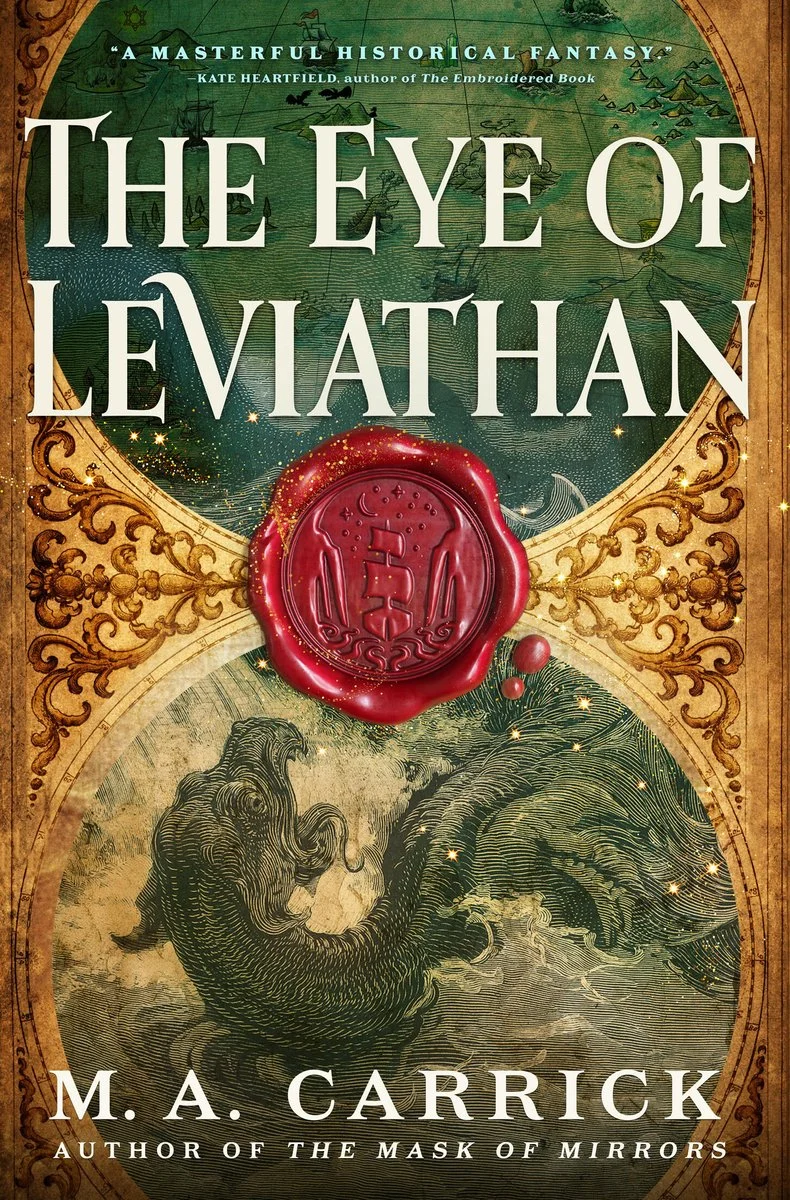
M.A. Carrick is joining us today to talk about their novel, The Eye of Leviathan. Here’s the publisher’s description:
In an alternate Spanish Golden Age, the Council of the Sea Beyond has risen to unrivaled power, exploiting the Otherworld’s most precious resources for their own gain. Estevan seeks to uncover their secrets, but he risks the exposure of his own: that he is a faerie, masquerading as a mortal.
The Hungry Girl is the human whose place he took. Lost among the fae and desperate to find some purpose for her existence, she leaps at the chance to help a group of Spanish explorers in the Sea Beyond … only to be horrified at the atrocities they commit.
A faerie pact has separated them–but only together can they bring down Spain’s worlds-spanning empire and save the homes they have both come to love.
What’s M.A. Carrick’s favorite bit?
We (Marie and Alyc) have a file in our shared drive titled “cosmological murder board.”
You know that meme image from It’s Always Sunny in Philadelphia, of the crazy-looking guy standing in front of a board covered with notes and red string? Our file is just a text document, but it has those vibes. Because the further we waded into the invented cosmology for our alternate history duology, the more connections we found, until we started to feel like unhinged conspiracy theorists.
It started with Hercules. The Sea Beyond — the Otherworldly ocean full of faerie islands that is the focus of our series — is reachable by sailing from the Mediterranean through the Strait of Gibraltar. In lore, of course, the mountains on either side are referred to as the Pillars of Hercules: the Rock of Gibraltar to the north, and to the south . . . that one’s a bit more disputed; it’s either Monte Hacho or Jebel Musa. Supposedly, inscribed upon the Pillars was the phrase non plus ultra: “nothing more beyond.” (If you’d like a taster for the novels, we have a prequel story, “Non Plus Ultra,” that’s free to read online!)
Now, stories about the Pillars differ. Some say Hercules pushed the mountains apart to let the sea through into the Mediterranean basin. Others say he pulled them together to close the passage off into a strait. You know what else has similar ambiguity? Samson and the temple of the Philistines. Whether he brought the temple down by pushing the pillars apart or dragging them together depends on who you ask.
Or go in another direction, and you find that Hercules has a lot in common with the Phoenician deity Melqart. Also, Alexander the Great liked to depict himself with the iconography or Hercules, and surely he would have tried to conquer the Sea Beyond. Also also, there’s a ton of legends associating Hercules with Spain . . . including one that he founded the University of Salamanca (!?), which we tragically did not manage to work into the book.
Separately — at the outset, anyway — we began developing some ideas about Leviathan and Behemoth. These two creatures show up in the Bible, with other lore accreted on through Jewish writings, Christian apocrypha, and so forth. Since we’re writing about a mystical ocean, Leviathan was a natural fit . . . at which point Behemoth was the obvious representation for the terrestrial, mortal world. Behemoth also supposedly dwells in a land to the east, and if the Sea Beyond lies “west” through the Pillars, doesn’t that make the entire mortal world “east”?
From there, everything started gathering momentum. Behemoth is often depicted in bull-like form. Didn’t Hercules steal some cattle from Geryon? Who lived on Erytheia — an island in the far west? Plus Spain and its tradition of bull-fighting are right there. Wait, there’s a river in western Spain, the Río Tinto, whose waters run red because they’re naturally poisoned with heavy metals leaching into the water . . . including iron. The traditional bane of fae. Now we’re cooking with alchemy! Behemoth’s blood is iron (the Río Tinto is where he was killed by Hercules/Samson/Melqart), while Leviathan’s blood is orichalcum, a red metal associated with Atlantis (another mythical island!). Gold is the most noble metal, lead the most base; iron the most mortal, orichalcum the most eternal. Where those two axes cross, you have quicksilver: the metal that acts like water, and we’d already decided that water is the medium of metaphysical transition. It’s why you have to sail to the Sea Beyond; it’s why baptism can forcibly shift fae from their own cosmology to the Catholic framework; it’s why transit between realms can only happen when the planet Mercury is moving in retrograde —
Hang on, Mercury. In Christian astrology, that planet is ruled by the archangel Raphael, whose element is water. In a Hispano-Arabic version of the bonkers text (almost a genre in its own right) known as the Alexander Romance, Alexander the Great was tutored by the angel Zayaqil, i.e. Raphael. Except there he’s called Dhu al-Qarnayn, “the two-horned one” — and okay, sure, Alexander got that name from doing a rite at the temple of Zeus Ammon in Egypt, where the horns in question are ram’s horns instead of a bull’s, but on the Sea Beyond side of the passage the Pillars of Hercules are instead the Horns of Behemoth. That whole bit about the Gates of Alexander, which he built to hold out the nations of Gog and Magog? What if that refers instead to the Horns, and the fae, and why passage between the worlds is so difficult to make nowadays?
Don’t even get us started on the entire rabbit hole you can fall down concerning the Arabic figure of al-Khidr! (Mostly because that would entail too many plot spoilers.) Let’s just say there are entire paragraphs devoted to him and related individuals in our cosmological murder board.
Basically, we discovered that you can’t tug on one thread in Mediterranean lore without dragging six others along with it. And to us — a pair of former academic folklorists — that’s delightful. Fantasy novels often present organized, clear-cut cosmologies, but real world cultures overlap and develop contradictory stories and generally create a glorious mess. If our Rook and Rose epic fantasy trilogy was “when anthropologists attack,” this duology is “when folklorists get to play in the mud.” We absolutely adore having the chance to waltz with all these interlocking ideas . . . even if we start sounding like unhinged conspiracy theorists when we try to explain.
Welcome to our alternate history. If you think you see a resonance with some story or myth you know, you’re probably right. After all, in the Sea Beyond, all things are possible!
LINKS:
Backerkit – Pre-order Pattern Deck from The Rook and Rose
BIO:
M.A. Carrick is the joint pen name of Marie Brennan (author of the Memoirs of Lady Trent) and Alyc Helms (author of the Adventures of Mr. Mystic). The two met in 2000 on an archaeological dig in Wales and Ireland — including a stint in the town of Carrickmacross — and have built their friendship through two decades of anthropology, writing, and gaming. Previously they collaborated on the Rook and Rose trilogy, beginning with The Mask of Mirrors. They live in the San Francisco Bay Area.
*Mary Robinette an affiliate of Bookshop.org and will earn a commission if you click through and make a purchase. This does not increase your cost; it simply helps support her work