
C.J. Beshara is joining us today to talk about their novel, Lucianus. Here’s the publisher’s description:
Lucianus is one of the most destructive wizards of all time. For his crimes, he was executed.
To his shock he awakens, in a body not his own, summoned by powerful magic with no clue as to why. He’s soon discovered by Auran, a knife-wielding traveler suspicious of his strange and sudden presence. Displaced from his own era and at a loss for what to do, Lucianus begs Auran’s help in finding his feet. Auran reluctantly agrees, and so together they strike out across the changed lands Lucianus once called home, looking for an explanation.
The purpose of Lucianus’ summoning soon becomes clear: he’s been tasked with murder, as befits his violent reputation as a battlewizard. Yet what should be a straightforward objective turns complicated, for the spell that binds him to life will end once the task is complete. His body is borrowed. His time is short. He must reach the appointed place and complete his task…but that means a return to death, and there’s nothing he wants less. He’d rather enjoy this borrowed life for himself. And Auran, though he proves a competent guide, seems to have his own purposes, purposes that may go against what Lucianus’ summoner wants.
The scars of his past rise against him, a decades-old drama closes in, and still his fate is sealed. Lucianus will die a second time. What happens until then is up to him.
What’s C.J. Beshara’s favorite bit?
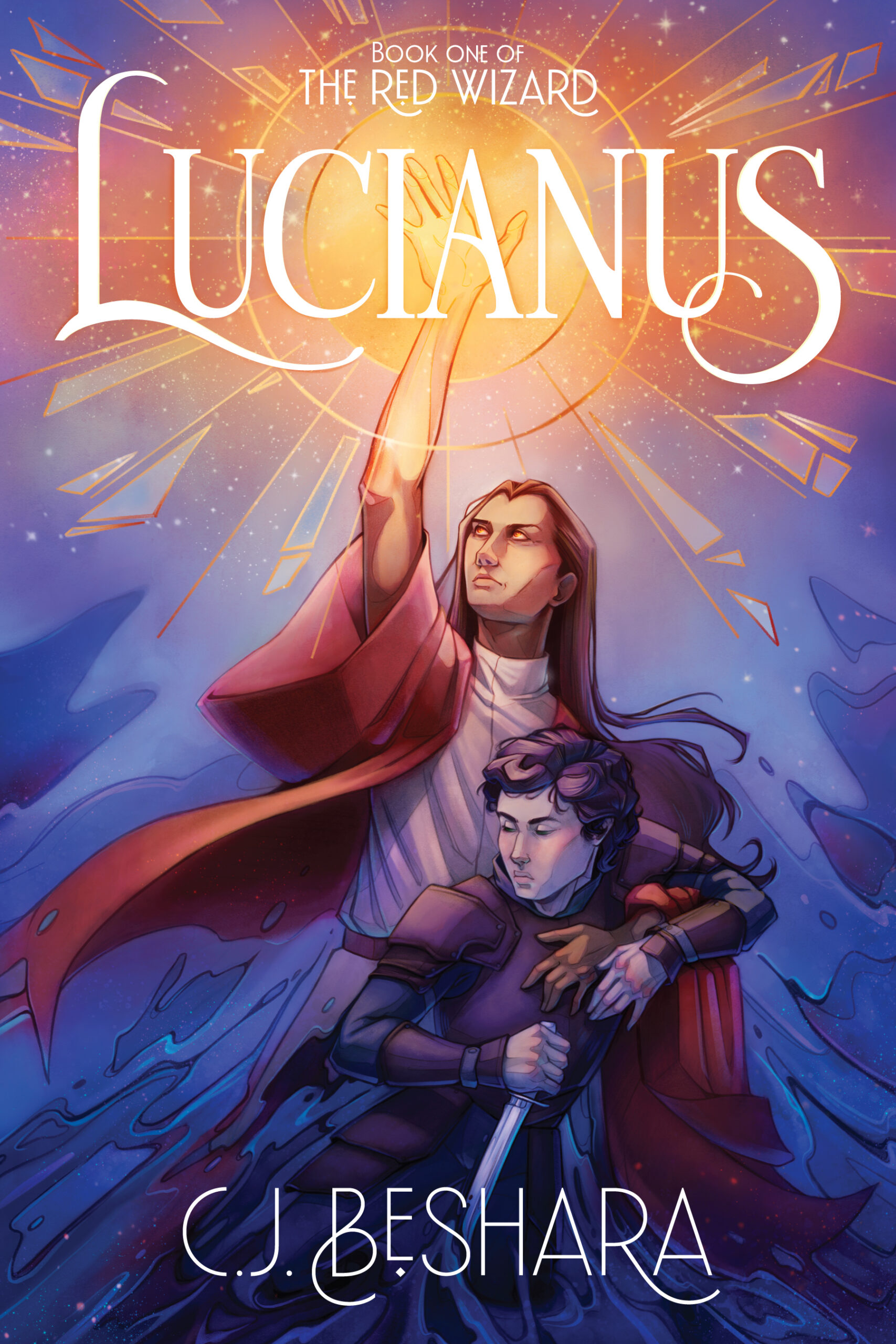
Lucianus is a fantasy novel about a long-dead and very destructive wizard, now resurrected by magic for one final task. On the surface it’s simply a magical adventure to defeat a big bad—a story told many times and in many different ways—but here it’s also a vehicle for examination of character, of death itself, and the impressions we leave behind once we’re gone.
I like stories with unreliable narrators, and while Lucianus is mostly trustworthy, this book is told directly through his voice, and thus he tends to spin events in his favor. He is slow to reveal the crueler aspects of his previous life. He feels guilt for his mistakes, and yet is prone to attempting justification. He presents himself as fundamentally good, with the best of intentions, only led astray by the beckoning of power and the flattery of others. The reader can even see that present-day Lucianus seems like a pretty decent guy. He’s been thrown into a bad situation, and he’s trying to make the best of it. But his reputation, as far as others in his world are concerned, is that of a villain—his power feared, his actions maligned, and his existence brought to an untimely and well-deserved end.
It may be confusing at first, to see this social, lighthearted, seemingly clever character viewed by his world’s history in such a negative light. He doesn’t feel like a villain, because to himself, he’s not. He made mistakes, he knows this, but he still thinks of himself as good. The reader can choose to believe him, and perhaps judge that the current events of Lucianus matter more than whatever he might have done in the past. Or, maybe they can’t, and the reader ends the book with a very mixed impression of the character.
This is my favorite bit of Lucianus. I’m fascinated by that disconnect between how we view ourselves versus how others might view us, and that’s why it’s one of the narrative’s main themes. The fact is we don’t know the sort of impression we’re giving of ourselves, and while we can try our best to ensure it’s a good one, we don’t have total control of it either. Our actions will paint a picture that we can never see. We know too much of our own noise, all the feelings, intentions, and decisions that go into everything we do or say, and thus the end result of what actually impacts the audience—be it one person, or many—is unclear to us. It’s too colored by our internal experience. Yet to the audience, this outward picture is all they know. I would argue that for better or worse, this external image that touches the outside world is who we really are—not the internal noise in which we spend most of our time.
That external impression, that picture, is something none of us will ever see of ourselves. We can’t. Lucianus can’t see his picture either, and he is particularly ignorant of that fact. Even during his own life, he was warned of the impact he was leaving, and he dismissed it, perhaps thinking he would eventually reach a great victory that would overshadow whatever came before. Well, as the narrative makes clear, this didn’t happen. Lucianus is remembered poorly, when he is remembered at all, and that fact is at complete odds with his narrative. He believes he is the one that really knows himself. He believes he is good.
Well as we established, it isn’t up to him. Thus it falls to you, dear reader, should you choose to join Lucianus on this bizarre adventure through his brief second life—what sort of person is he really? Is he the personable, funny, well-meaning narrator now reborn and freed from the pitfalls of his past? Or is he a terrible wizard led by ego, a villain of his time, best left in the war-torn past from which he came?
Either way, I think it makes for an interesting time.
LINKS:
BIO:
C.J. Beshara is a nonbinary fantasy and science fiction author from New England.
*Mary Robinette an affiliate of Bookshop.org and will earn a commission if you click through and make a purchase. This does not increase your cost; it simply helps support her work