
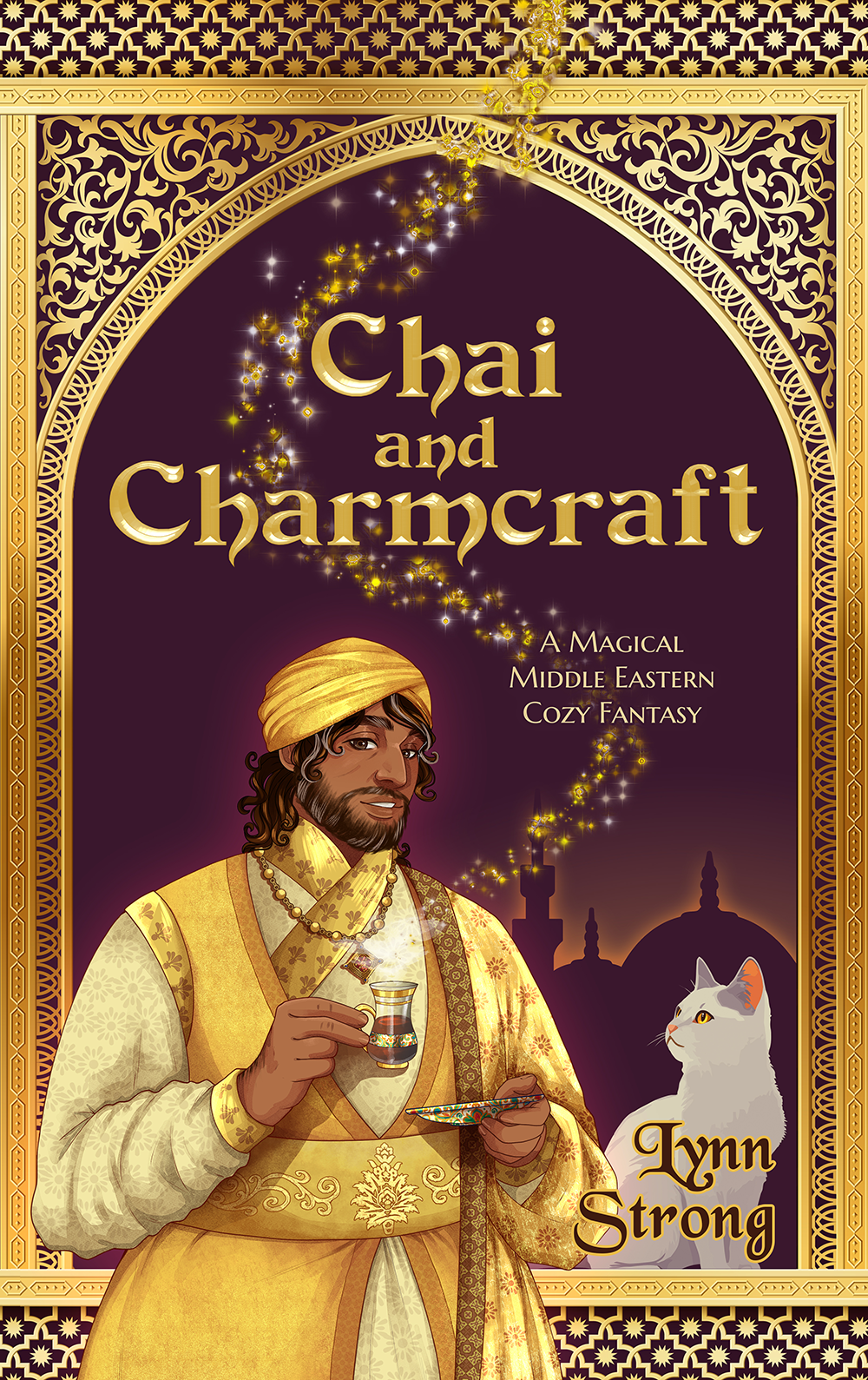
Lynn Strong is joining us today to talk about their novel, Chai and Charmcraft. Here’s the publisher’s description:
His Imperial Highness Faraj al-Nadhir has never thought himself a charming sort of prince. He’s shy, round, middle-aged, and always dutiful. But he has also secretly spent years dreaming of a man tending jasmine in a star-lit window — prophetic visions that led him at last to one blissful night with someone who sees his heart, not his crown.
He did not expect to wake up with a cat walking on his face.
Cat-familiars are forbidden in the Imperial fortress. They might be spies. They might be soul-charmers. They might even sharpen their claws on thousand-year-old tapestries. But Faraj cannot regret that sweet little Sahar chose him — just as he cannot regret Asharan bir Chameli, the enchanting owner of the House of Jasmines. Asharan wants nothing to do with Faraj’s title and power, only his kindness. And Faraj hadn’t expected either the delights or the dilemmas of Asharan’s magical, soft-pawed little gift.
The rules have always been different for the God-Emperor’s brother. Faraj never before realized how much.
Now he’s breakfasting from community cauldrons in back alleys full of children and kittens. His foresight shows him a thousand paths toward disaster, but not the way through. His devoted chamberlain fears that Faraj has been bewitched by a purring agent of chaos, and Faraj can’t exactly say he’s wrong.
When the choice comes down to betraying his lover’s name, his cat-familiar’s life, or his own use of forbidden magic, Faraj does the only thing he can: He gets himself put on trial for heresy, trying to change the laws of the Empire itself.
If his visions always lead him into trouble, he might as well make useful trouble.
What’s Lynn’s favorite bit?
I had a hard time deciding what was my favorite bit from Chai and Charmcraft, because in a lot of ways this is the book of my heart.
I do set out to flip the narrative expectations: In a book about the medieval Middle East, there’s no crusades, no assassins, no backstabbing and treachery, not even djinn trapped in lamps. In a cozily subversive flipping of Cinderella’s tropes, the Cinderella character is just as much the Fairy Godfather, because Ashar has magic of his own.
Ashar’s business sells comfort, pleasure, and spa-type bath-relaxation. But his business is not about makeovers, because he fiercely believes that nothing around him needs a makeover to be loved. He loves his home and his neighborhood exactly as they are, no gentrification needed. And he loves the story’s Prince Charming exactly as he is too, even when Prince Charming would rather audit a dragon than slay one.
The prologue is the Cinderella-flipped short story Nathaniel Webb published in Wyngraf’s 2024 Valentine’s Special. But then I wondered “what would it actually take for two people this different to find a happily ever after?” The answer turned into a trilogy.
So Faraj, the sweet, shy, middle-aged, round bureaucrat of a prince, has been prophetically dreaming of Asharan’s hands for years… but Faraj is a nadhir prophet who foresees disasters.
Even without treachery and backstabbing, Faraj needs to change both the world and his own self-image first. He’s dutifully spent his whole life trying not to cause trouble. But as he notes, “Just because an injustice has become traditional does not make it right.”
Sometimes you have to make just enough trouble to change things for the better. Even if that means defying expectations to make room for either your hope of love or your mischievous new cat-familiar who expects to be worshiped as a goddess, like any cat does. (This is supremely awkward when your brother is the God-Emperor and you’re his prophet!)
I really enjoyed writing fun cat-culture details like catfolk getting hennaed leopard spots as a fashion statement, bragging about their hunting-ability to hold very, very still.
But I think my favorite bit is a scene with Faraj, his very stressed chamberlain Irfan, a young shepherd-priest named Elias, and a basket of treats and poetry.
By this point, Irfan knows that Faraj has brought home a cat-familiar whom some sorcerer has bonded to his soul. Usually, that would mean some sorcerer wanted to wedge a charming, purring spy into the palace. And a prince who had been mind-influenced would defend the charmcrafter who did it.
In many other books, Irfan could have been the hero rescuing his prince from malign influences! It’s not Irfan’s fault he can’t trust the changes he’s seeing. There aren’t any villains here. But Faraj and Irfan are definitely in conflict at this point.
So Irfan is fighting off a tension-headache while rushing to finish the menu for the evening’s grand formal dinner, and shepherd Elias comes in with the gift-basket.
Faraj is learning the value of relaxation from his new cat-familiar and his shepherd-guest. So instead of pushing harder for the deadline, he encourages them all to pause for appreciation first. Yes, this is unlike the person he’s always been before, and yes, it looks like outside influence. But this outside influence has nothing to do with magic, just encountering others’ perspectives.
Diversity is not a bad word, current federal mandates aside. In this case, it’s diversity of thoughts, cultures, and approaches to time, with a dose of compassionate care.
The treat-baskets are a delightful historical touch in one of the 10th to 14th century Egyptian cookbook translations I read for research. In the days before Hallmark cards, literate Egyptians would send each other treats and poetry. And before cameras, the poetry written in the cookbooks (describing the lush pleasures of the food someone had skillfully cooked from these recipes) served as the equivalent of Instagram and food blogging. In one adorable case, a nephew sent his uncle a cookie-basket with poetry and received a poem of gratitude in return.
So that’s the historical heart of the scene, along with taking time to appreciate both food and literature no matter how the grindstone of the world demands your time and energy.
The “write what you know” adage is coming out here. Obviously I’m not a prophet or a magical cat. But I have regular migraines that I have to work through; I haven’t had a day entirely off work since I started self publishing in 2024. I see the irony that I’m writing this on a weekend through an eyestrain headache because I haven’t learned my own lessons. Still, the flip side is that Official Permission to Relax is wish fulfillment! I’ve spent enough time in other countries where clocks don’t rule everything to appreciate different values about food, time, and priorities.
So I love that scene. I love the history. I love the permission to prioritize humanity and compassion over social expectations. Elias, a shepherd who waits around for sheep, brings a busy prince a gift that needs time to savor rather than wealth to buy. A protagonist and antagonist in story-conflict still think of each other’s well-being more than their disagreements. Faraj tells Irfan to rest, not to push through pain for a deadline. I loved writing the food-poetry. I extra love the delicious snacks in their treat-basket! (Recipes are in the appendix.)
I write a world I want to see more of, including and appreciating diverse people and world-views and time-views. Whether brown, queer, neurodiverse, fat, middle-aged, disabled, of differing faiths, or any other form of othered-ness, my books’ heroes are people who don’t usually get to see ourselves as heroes. And nobody needs a makeover to be loved here, though we might need a spa day or some compassionate encouragement to escape the societal grinds and recover before picking up the work again. So that’s why that scene is my favorite bit.
LINKS:
BIO:
Lynn Strong (MLIS & any/none) is a questionably recovered wordaholic who used to be paid by the column-inch. (It likely still shows.) Lynn has lived on three continents, speaks parts of six languages (and counting!), and at one point semi-professionally burned Kool-aid on the job.
Lynn’s always seen the world a little differently, being low vision, queer, and neurospicy. But not to worry: most of the spice in these books goes into the recipe collections!
*Mary Robinette an affiliate of Bookshop.org and will earn a commission if you click through and make a purchase. This does not increase your cost; it simply helps support her work