
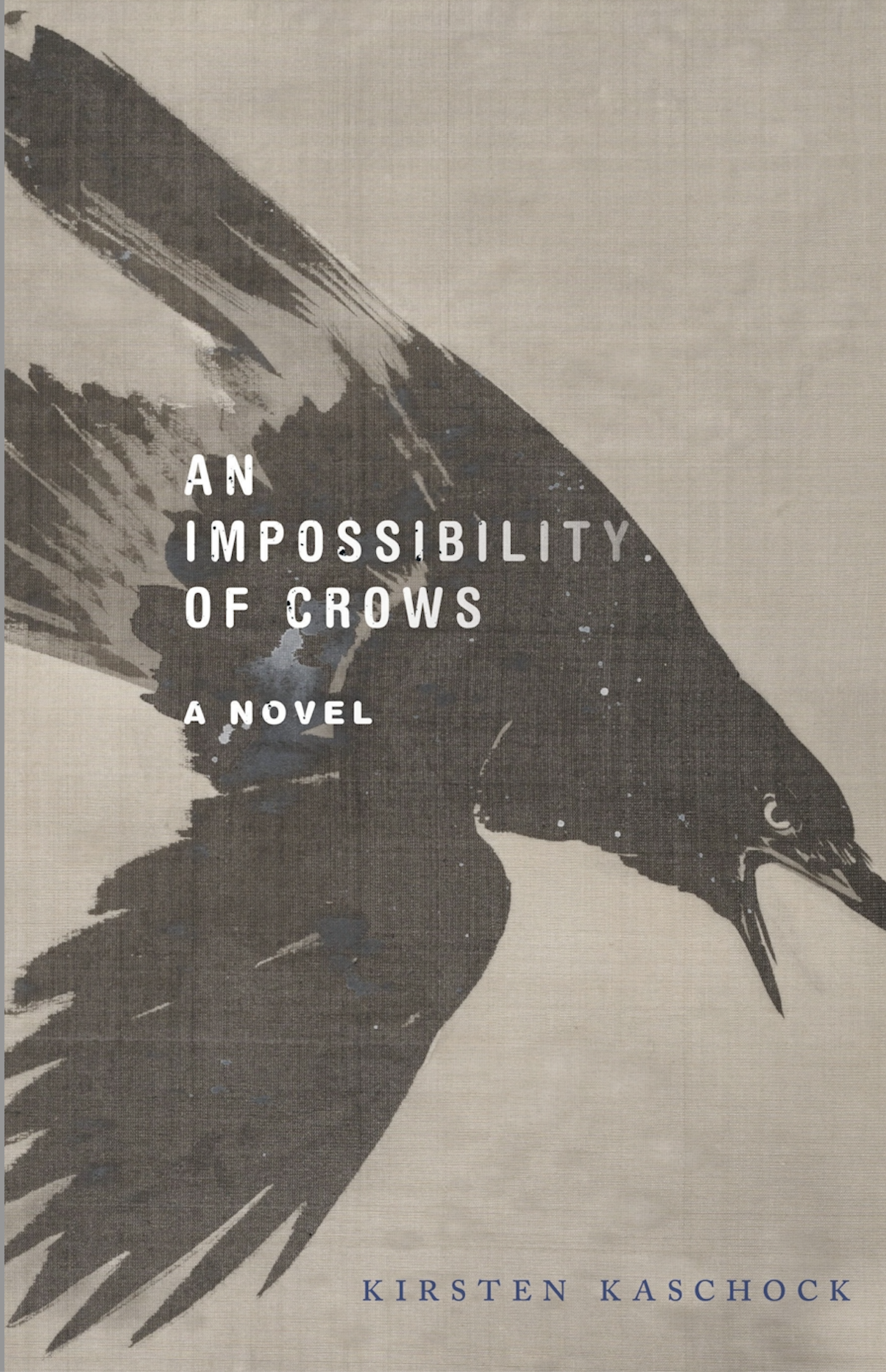
Kirsten Kaschock is joining us today to talk about her novel, An Impossibility of Crows. Here’s the publisher’s description:
In this daring and evocative tale, Agnes Krahn, a chemist trained in Philadelphia, returns to her childhood home after the death of her father. Just a stone’s throw from the haunted fields of Gettysburg, the small town of Letort, Pennsylvania is where the Krahn family has lived for six generations–bound by twisted folk wisdom and an uncanny kinship with the crows that loom over their land.
Back in the grim farmhouse of her youth, Agnes is drawn into the strange legacy she tried to leave behind. When she discovers an abandoned nest in the barn, she becomes consumed by a scientific–and deeply personal–experiment: to breed a crow large and intelligent enough to carry her daughter, Mina, to a freedom Agnes has never known herself. As the bird grows, so does its terrifying potential–manifest in language, cunning, and a violent will of its own. What begins as a gesture of love and liberation turns darkly obsessive, echoing the dangerous ambition of Frankenstein’s monster and the generational trauma buried in the soil of her family’s past.
A thoroughly modern, feminist novel, this is a story of mothers and daughters, inheritance and isolation, and the thin line between care and control. It confronts themes of self-harm and self-preservation, as well as memory and myth, in a narrative as visceral and uncanny as the bird that rises at its heart.
What’s Kirsten’s favorite bit?
I set out to create a mad scientist I could believe in—even (god forbid!) empathize with. Since Victor Frankenstein, there have been a slew of fictional unhinged researchers, professors, and inventors. Most of them men. They show up in classic sci-fi (Dr. Moreau), all over comix (Otto Octavius, for example), on acclaimed television shows (Walter White), and even in cartoons (looking at you, Rick Sanchez). But few of these notable characters have a backstory that makes sense to me. They just seem to be very smart people whose narcissism and disdain for others got the best of them. Lame.
I wanted to write Agnes Krahn as a scientist capable of amazing things whose experiences twist her in a way a reader can understand—even if they would have made different decisions. Figuring out who Agnes was as I wrote her was a dark but pleasurable puzzle. I knew how she thought, maybe intuitively, but I didn’t know—at least not at first—why she thought that way.
Chapter by chapter, I came to understand that it wasn’t one thing that created Agnes—not a cold and unapproachable father, not a strange then absent mother. It wasn’t just the difficult rural life that clearly didn’t suit her or the gothic landscape enshrouding her past. After all, her sister grows into an entirely different kind of person. Agnes’s education and her time in a chemistry lab certainly leave their marks on her and her family, but these are not definitive either.
Eventually I learned what Agnes is not: an insanely ambitious egoist. She breeds a crow the size of a horse not because she wants to show the world her genius… but out of mounting guilt. The final straw comes when she returns to the site of her own childhood and realizes she does not know how to love her only daughter. She was never shown how. The crow, Solo, is Agnes’s misguided attempt to somehow manifest that love.
When I set out to create Agnes, I started with Frankenstein, a man who thought he could reverse illness and death with science. I ended up with a collapsed version of the Greek myth of Daedalus and Icarus. In that story, Daedalus builds wings to help his son fly from an island prison, but Icarus cannot help but steer into the sun. Because Agnes relies only on herself, she plays both parts in this retelling, and as a result she gets turned around, locked inside her dream of escape. The bird grows more important to her than the reason she built him.
As an artist, I understand how what a person makes can become central to their identity. I also know not everyone will understand Agnes’s narrowing of vision. She is undoubtedly a kind of villain, and I find villains fascinating. But she is also a daughter and a sister and a mother who feels ill-suited to almost everything that has ever been asked of her. Science, for her, is the one place she has ever felt competent. It’s not shocking that she puts all her eggs into that basket then, is it? Or that she clings hard to the creature she sacrifices nearly everything to hatch?
LINKS:
BIO:
About Kirsten Kaschock is a poet and novelist who writes across genres. Her background in dance has impacted her work—she consistently addresses intersections between language and body. She is the author of seven poetry books and has received fellowships from the Pew Foundation, the Pennsylvania Council on the Arts, Vermont Studio Center, Subcircle, and the Summer Literary Seminars. Coffee House Press published her debut speculative novel— Sleight . She has lived in Iowa, New York, Georgia, and Maryland—and currently resides in Northeast Pennsylvania with her partner. Her work has been called “gothic and intense,” “as fascinating as it is disturbing,” “inventive and exhilarating.” As Cheryl Strayed once noted: “There isn’t anyone like any single one of us, but the way there is no one like Kirsten Kaschock is a different thing.”
*Mary Robinette an affiliate of Bookshop.org and will earn a commission if you click through and make a purchase. This does not increase your cost; it simply helps support her work