
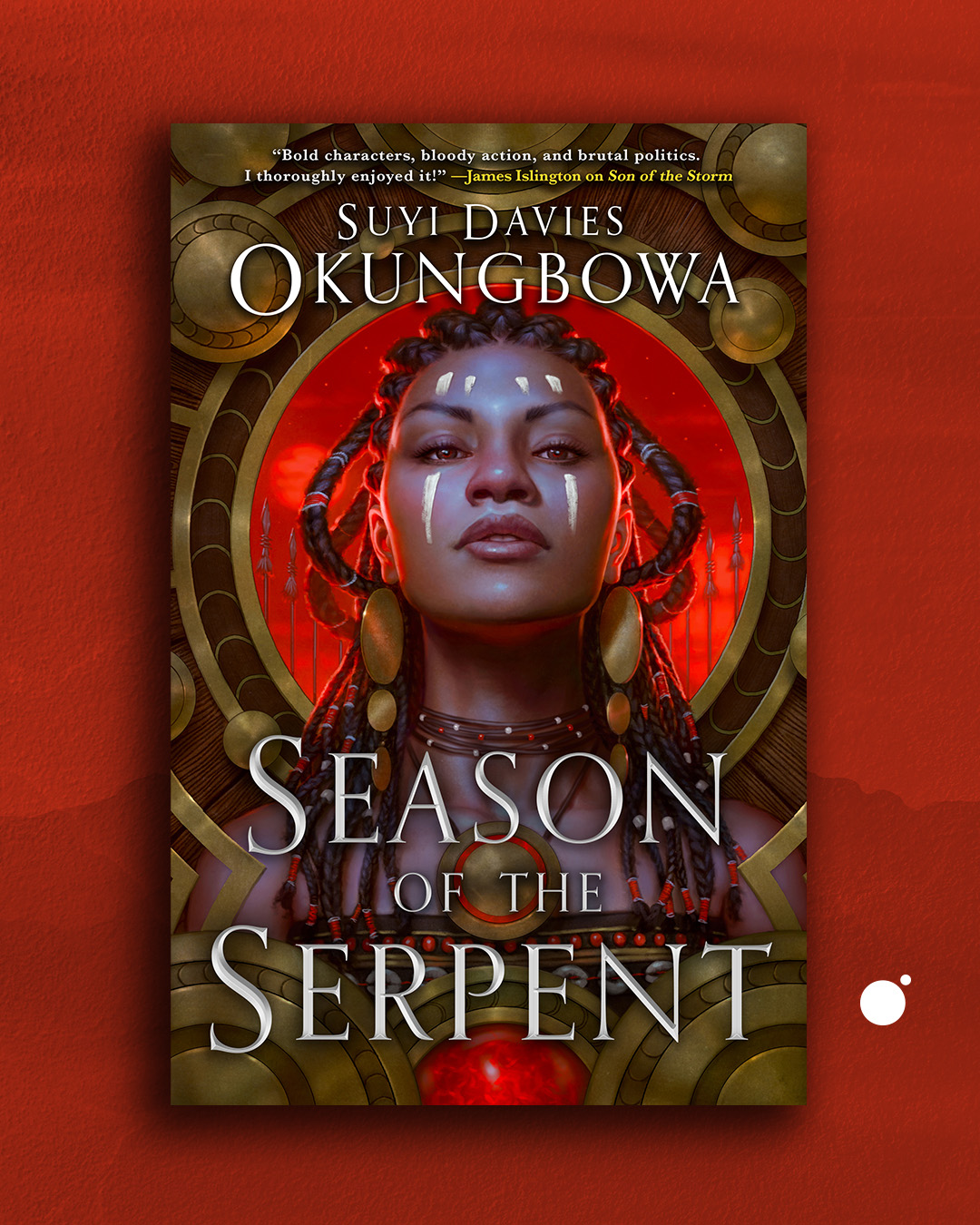
Suyi Davies Okungbowa is joining us today to talk about his novel, Season of the Serpent. Here’s the publisher’s description:
The old world has fallen. Now is the time of serpents.
The continent is split. The islands have sunk. The empire of Bassa is no more. With the resistant Nameless Republic and the conquering Kangalaland on the brink of war, all must choose a side: ally, or fall. Oon’s heroes and villains must rise from their ashes and meet a Third Great War.
Peace won’t come easy. Long-lost family will fight to reach Danso before war erases him forever. Lilong has survived the island catastrophe but lost her power, and will do anything to get it back. And fate will find Esheme where it left her–will the dead queen rise again?
For Oon, the first season of the five states is a season of serpents. After the storms pass and winds blow, what will remain? And who will survive?
What’s the author’s favorite bit?
I did not encounter the expression “found family” until I began reading mainstream fantasy, though I was familiar with the concept long before encountering this language for it. Prior to becoming enthralled by fantastic works set in secondary-world milieus, I’d encountered other kinds of speculative narratives—say, oral epics and legends like Chaka or The Odyssey or creation stories of various cosmologies—as well as a bevy of West African and European fables, folktales and fairy tales. I was therefore familiar with the concept of a person of humble origins setting off on a long and noble quest, with the aim of achieving some kind of collective good, adopting fellow noble stragglers along the way, and together forming a lifelong familial bond, whether the quest itself ended up successful or not.
If one were to ask me what has become My Favourite Bit about The Nameless Republic trilogy, I’d say it’s literally the friends we found along the way; or rather, the families characters become along the way. It turns out the found family has, unwittingly, long been a staple of my own storytelling—both in this series and in the novels before and after it. A sort of signature mark you’ll find imprinted upon every Suyi tale, whether it is specifically intended or not.
When I set out to write The Nameless Republic trilogy, I did not go in with the intention of making found families central to its narrative. My aim was mostly to employ the trappings of the epic-quest-as-narrative-form, with the African oral epic as a bedrock, and then adopt some of the overtones of mainstream secondary-world fantasy—the vast, sprawling milieus; the fantastic magical beasts; the political intrigue and shenanigans; and the merry bands of lovable rogues who, as I would come to recognise, form found families. Over the course of three books, major and minor characters would emerge—across journeys, quests, kingdoms, wars—with familial bonds and connections that transcend creed, ethnicity, identity.
I think the found family as a concept interests me as a storyteller because my stories, in general, are interested in excavating the wonders and tragedies of the human condition, investigating our kinks and marveling at our capacity for embrace. Found families are the positive manifestation of the best qualities of the
human condition—discovering those like and unlike us, and in spite of all their human fallibilities, choosing to look on their bright sides and embrace them anyway. In today’s world where division is rife, hate is engineered, and fortunes are made by capitalizing more on that which separates us than that which unites us, found families are a reminder of what we are capable of—our human ability to step beyond the single, the insular, the divided, and reach across to connect with those who seek connection with us, and together achieve magnificent goals, no matter how insurmountable they may seem
LINKS:
BIO:
Suyi Davies Okungbowa is an award-winning author of speculative fiction. His latest books include the science fiction novella Lost Ark Dreaming (Ignyte & Nommo award winner; Nebula Award finalist); the Nameless Republic trilogy (beginning with Son of the Storm and concluding with Season of the Serpent); and The Intergalactic Empire of Wakanda, a Black Panther novel. His shorter works have appeared in various periodicals and anthologies and have been nominated for various awards. He earned his degree in Creative Writing from the University of Arizona, and lives in Ontario, where he is a professor of creative writing at the University of Ottawa. You can find him online at @suyidavies, or via his newsletter, SuyiAfterFive.com.
*Mary Robinette an affiliate of Bookshop.org and will earn a commission if you click through and make a purchase. This does not increase your cost; it simply helps support her work