
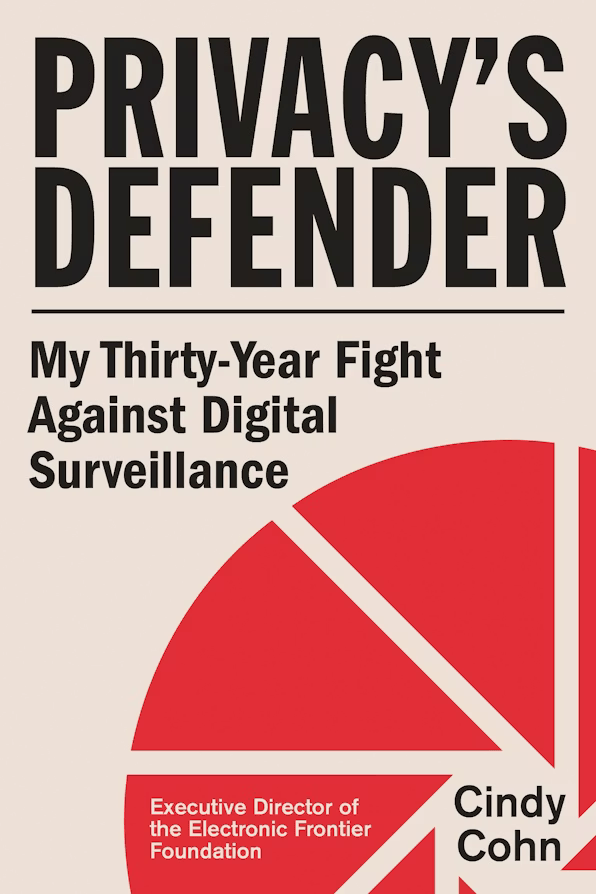
Cindy Cohn is joining us today to talk about her novel, Privacy’s Defender: My Thirty-Year Fight. Here’s the publisher’s description:
Throughout her career, Cindy Cohn has been driven by a fundamental question: Can we still have private conversations if we live our lives online? Privacy’s Defender chronicles her thirty-year battle to protect our right to digital privacy and shows just how central this right is to all our other rights, including our ability to organize and make change in the world.
Shattering the hypermasculine myth that our digital reality was solely the work of a handful of charismatic tech founders, the author weaves her own personal story with the history of Crypto Wars, FBI gag orders, and the post-9/11 surveillance state. She describes how she became a seasoned leader in the early digital rights movement, as well as how this work serendipitously helped her discover her birth parents and find her life partner. Along the way, she also details the development of the Electronic Frontier Foundation, which she grew from a ragtag group of lawyers and hackers into one of the most powerful digital rights organizations in the world.
Part memoir and part legal history for the general reader, the book is a compelling testament to just how hard-won the privacy rights we now enjoy as tech users are, but also how crucial these rights are in our efforts to combat authoritarianism, grow democracy, and strengthen other human rights.
What’s Cindy’s favorite bit?
In Privacy’s Defender I wanted to take readers on a journey and let them sit on my shoulder as I fought the legal battles to protect privacy — an exciting and sometimes wild ride. My
primary goal is to convince people that privacy matters and is worth defending. But my secondary goal is to recruit. Unlike journalists or academics who make compelling intellectual arguments, I wanted to give readers the feeling of living a life devoted to making the world better, its victories and bumps — whether in digital rights or anything else.
One of the book’s centerpieces is Edward Snowden, whose disclosures gave the world irrefutable proof that the government had been conducting mass surveillance on its own citizens and lying about it for years. But I didn’t just want to recount what happened — I wanted to capture how it felt to find yourself, and the cause you’ve given years of your life to, suddenly thrust into the white-hot center of global attention.
The Snowden section opens with a small, irritating mystery: a board meeting at the
Freedom of the Press Foundation, where two members — the filmmaker Laura Poitras and journalist Glenn Greenwald — are inexplicably absent. I then jump forward a few days to the moment I was pulled out of a staff interview at EFF to look at the first public revelation: a court order requiring Verizon to hand over the phone records of every single one of its customers. This was the mass collection program we had been suing over for seven years, one the government had spent seven years refusing to confirm or deny. One of the stories was written by Glenn – which solved part of the FPF Board meeting mystery. It was a
momentous milestone — though not yet a personal one.
My favorite bit comes next. I had just landed at Dulles Airport outside Washington D.C. and turned on my phone when it erupted — dinging loudly and incessantly as I tried to grab my roller bag and squeeze off the plane, drawing annoyed looks from everyone around me.
When I finally made it to the gate and looked at my phone, I understood why: the very first photograph of the whistleblower had just surfaced, and in it he was sitting behind a laptop with a large, red EFF sticker on the lid. The photo was by Laura, who had filmed Snowden in a Hong Kong hotel room. That solved the rest of the mystery.
Thanks to that photo, every major news outlet in the world wanted to know what we knew about Snowden. What followed was a blur of excitement and barely contained panic — on the inside. On the outside I was still in a drab, ordinary airport, surrounded by people
rushing from gate to gate.
I was overjoyed that someone who so clearly stood with EFF had taken such a courageous step — likely at enormous personal cost — to tell the public the truth, and in awe of the scope of what he had revealed. I was grateful that he had handed our case a lifeline. But I
had to set all of that aside to deal with the flood of press. What was this guy’s relationship with EFF? How did he get that sticker? Was he a member? Were we directly implicated in the leak? And would he even prove to be a credible messenger? I needed answers before I could start returning calls – and I still needed to find the exit.
That moment — my phone erupting amidst an ordinary disembarkation — still electrifies me. I hope I put the reader right there beside me.
LINKS:
BIO:
Cindy Cohn is Executive Director of the Electronic Frontier Foundation. From 2000 to 2015, she served as EFF’s Legal Director as well as its General Counsel. Today, she spearheads a team of more than 120 lawyers, activists, and technologists who are dedicated to ensuring that technology supports speech, privacy, and innovation for all the people of the world.
*Mary Robinette an affiliate of Bookshop.org and will earn a commission if you click through and make a purchase. This does not increase your cost; it simply helps support her work