
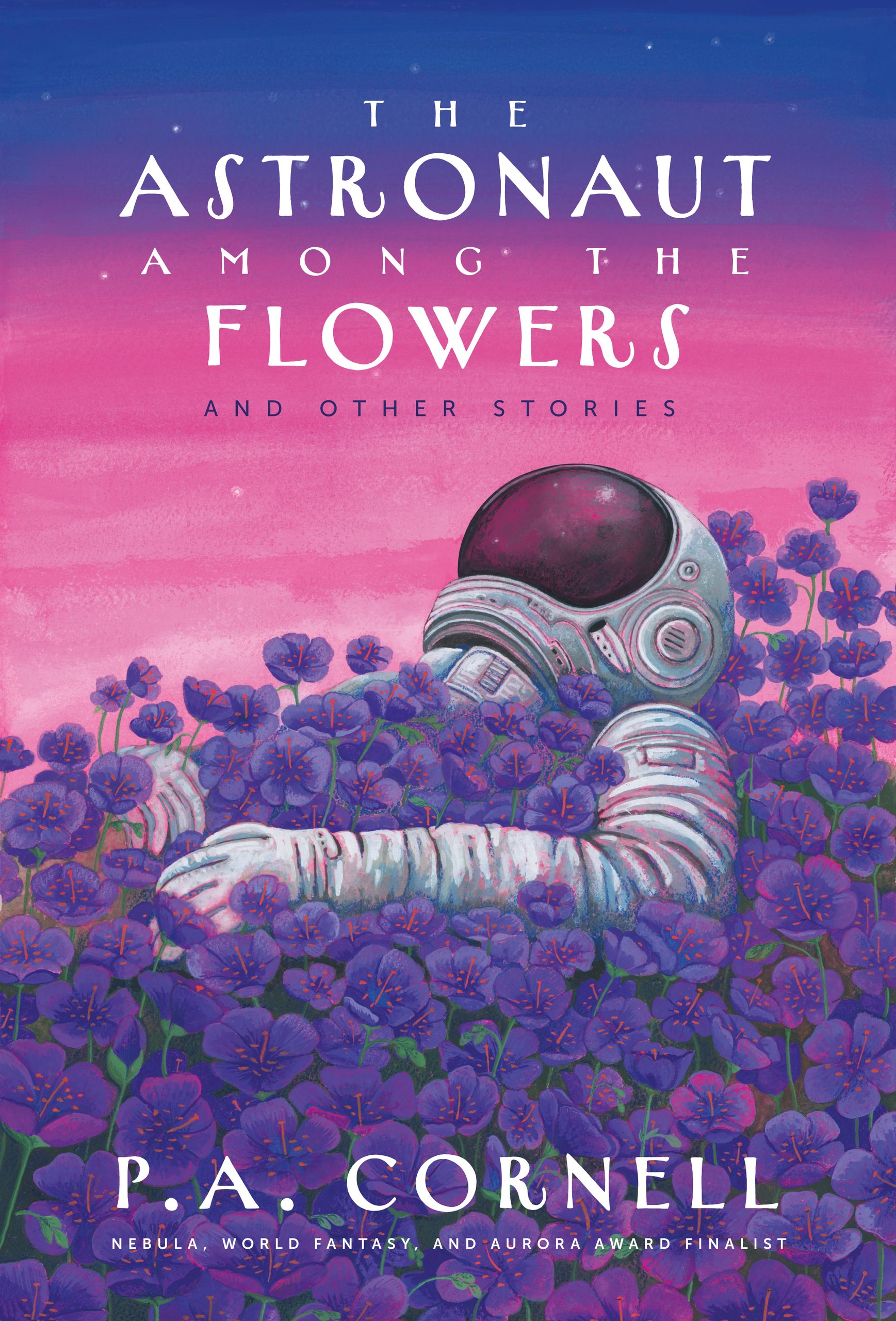
P.A. Cornell is joining us today to talk about her collection, The Astronaut Among the Flowers and Other Stories. Here’s the publisher’s description:
This debut collection by Nebula-nominated author P.A. Cornell brings together twenty-one tales of fantasy and science fiction that run the gamut from lighthearted to dark. The stories examine our connections to each other, to technology, to the world that surrounds us, and even to ourselves. Journey through circumstances that defy explanation, and explore events yet to come, that have come before, or that exist outside of time altogether. Included are Cornell’s acclaimed story “Once Upon a Time at The Oakmont,” as well as the award-winning “Splits,” and two brand new works published here for the first time.
What’s P.A. Cornell’s favorite bit?
In interviews I’m often asked about my influences and it’s tough to know what to say. I don’t have a standard answer. I can’t just rattle off a few well-known author names when in reality the things that make an impact on art can be so varied and in some cases aren’t even consciously influencing our choices. To be honest, I feel my influences aren’t so much other writers but just regular everyday people I’ve encountered throughout my life. I’ve always had an interest in why people do the things they do or think the way they think, and whether it’s possible to put yourself in someone else’s shoes, even when they’re a very different person from you?
When choosing the stories included in The Astronaut Among the Flowers and Other Stories, the primary unifying theme I had in mind was that of connection, but ultimately all the stories are about what it means to be human and how who we are determines how we act when confronted with challenges—even when those challenges are extreme or unusual.
If there’s one story I feel embodies all of this, it’s “The Smell of Sawdust,” which closes the collection. My fiction tends to be character-driven, and this one’s no exception. The main character is Julia, a middle-aged woman who also happens to be a cage fighter in a post-apocalyptic world. Julia has a secret: her hands are riddled with arthritis, and her days in the cage are numbered, putting her ongoing survival at risk.
I’ve lived with joint pain throughout my body for most of my life, something that’s worsened with age. Most of the time, you wouldn’t know it. It’s an invisible disability. Occasionally, I have flareups and because I’m a writer, the most common joints affected are often those I use when working: elbows, shoulders, and yes, my hands. It was during such a flareup, forced to take a writing pause to recover, that I first envisioned Julia and the kinds of challenges she faces in her reality.
This wasn’t my first time writing a post-apocalyptic story. Often, people want to know what lead to that kind of world. For me, though, that’s the least interesting thing about this subgenre. I don’t care so much how they got there; what I want to know is how someone for whom this is now reality, copes. And not some superhuman hero, but a regular person, like myself, and like many readers out there.
On the surface, Julia might seem unremarkable when compared with other heroes we see in fiction. In her youth, she was a pianist. She was close with her father. Later, she wound up a cage fighter simply because it was her best chance at survival in her harsh world. She lives day to day. She endures.
Julia’s world is filled with violence, but from the get-go her strength and skill in the cage are on display. And yet, the story’s less about physical strength than inner strength. Outside the cage, Julia’s brand of strength can be subtle. Often, even in our real world, women employ a more understated kind of strength, since we’re allowed less leeway when it comes to expressing anger and frustration. Often, all we can do is endure.
It’s something I know many marginalized people understand. Those who, like Julia, are disabled know what it is to exist in a world that doesn’t necessarily accommodate your needs. Others know what it is to be treated as less-than simply because of skin color, sexual preference, religion, and more. Every day, we endure.
Sometimes, though, circumstances force you to do more than simply endure. That’s when you must draw strength from where you can and fight.
Julia reaches a point where she has no choice but to act, and when she does, she draws strength from her community, specifically the other women of her town. Some of them are fellow cage fighters, others not. One is just a girl she cares about and wants to see have a better life than the one she has. It’s the quiet support of this community that’s my favorite kind of strength on display here. It’s something women know well. We call it sisterhood, because it implies a familial bond.
The story has a lot to say about family, period. Aside from Julia’s found family of women in her present, she also reflects on a past with her biological family—in the form of her father. She draws strength from these memories but also looks forward to a promise of new-found community when she hears of a place filled with hope, where she won’t have to fight like she does now, and where she won’t simply be surviving, but actually living for the first time in too long.
If I’m asked about my influences where this story’s concerned, Julia originates from women I’ve known my whole life. Women who were dealt hard blows—figuratively, if not literally—but who kept getting up and kept fighting. Their strength wasn’t always obvious. They weren’t superheroes, they were just young girls, mothers, grandmothers, aunties, neighbors, friends. And yes, many of them faced physical challenges as well that didn’t take time off just because they already had enough problems to contend with. These women didn’t expect nor receive applause, deserved though this may have been. They would say, with all humility, that they did what they had to do and nothing more. Like Julia, they all invariably showed their greatest strength when someone they cared for needed them.
This story was written with women like that in mind, and is in a sense, a tribute to their resilience and quiet, understated, strength. We don’t all fight in a cage, but we do have to endure and fight in other ways sometimes. This story’s a reminder that as brutal as life might get, even small, simple actions can be a show of strength. Kindness can be a source of inspiration and hope. Empathy can be a superpower.
LINKS:
BIO:
P.A. Cornell is a Chilean-Canadian speculative fiction writer. A two-time finalist for the Nebula Award, her stories have been published in over seventy magazines and anthologies, including Lightspeed, Apex, and multiple “Best of the Year” anthologies. In addition to becoming the first Chilean Nebula finalist in 2024, Cornell has been a finalist for the Aurora and World Fantasy Awards, and in 2022 won Canada’s Short Works Prize. When not writing, she can be found assembling intricate LEGO builds or drinking ridiculous quantities of tea. Sometimes both. For more on the author and her work, visit her website pacornell.com.
*Mary Robinette an affiliate of Bookshop.org and will earn a commission if you click through and make a purchase. This does not increase your cost; it simply helps support her work