
Dmitri Mehlhorn is joining us today to talk about his novel, Archipelago of Light. Here’s the publisher’s description:
Across thirty-six years and six continents, the liberal order is dying, and seven strangers are building what comes next. A tech visionary and an engineer who thinks through his body. An intelligence analyst radicalized by a murder. A trafficking survivor who raises a criminal empire on synesthesia and the voices of the dead. A child soldier who feels human emotion like weather.
From their collisions rise rival operating systems for civilization itself: mesh networks keyed to children’s biometrics, AI churches that resurrect the dead, a regime that rewrites dissent at the neurochemical level.
As augmented reality shatters perception, one question remains–not who holds power, but whether we still share enough truth to survive.
What’s Dmitri’s favorite bit?
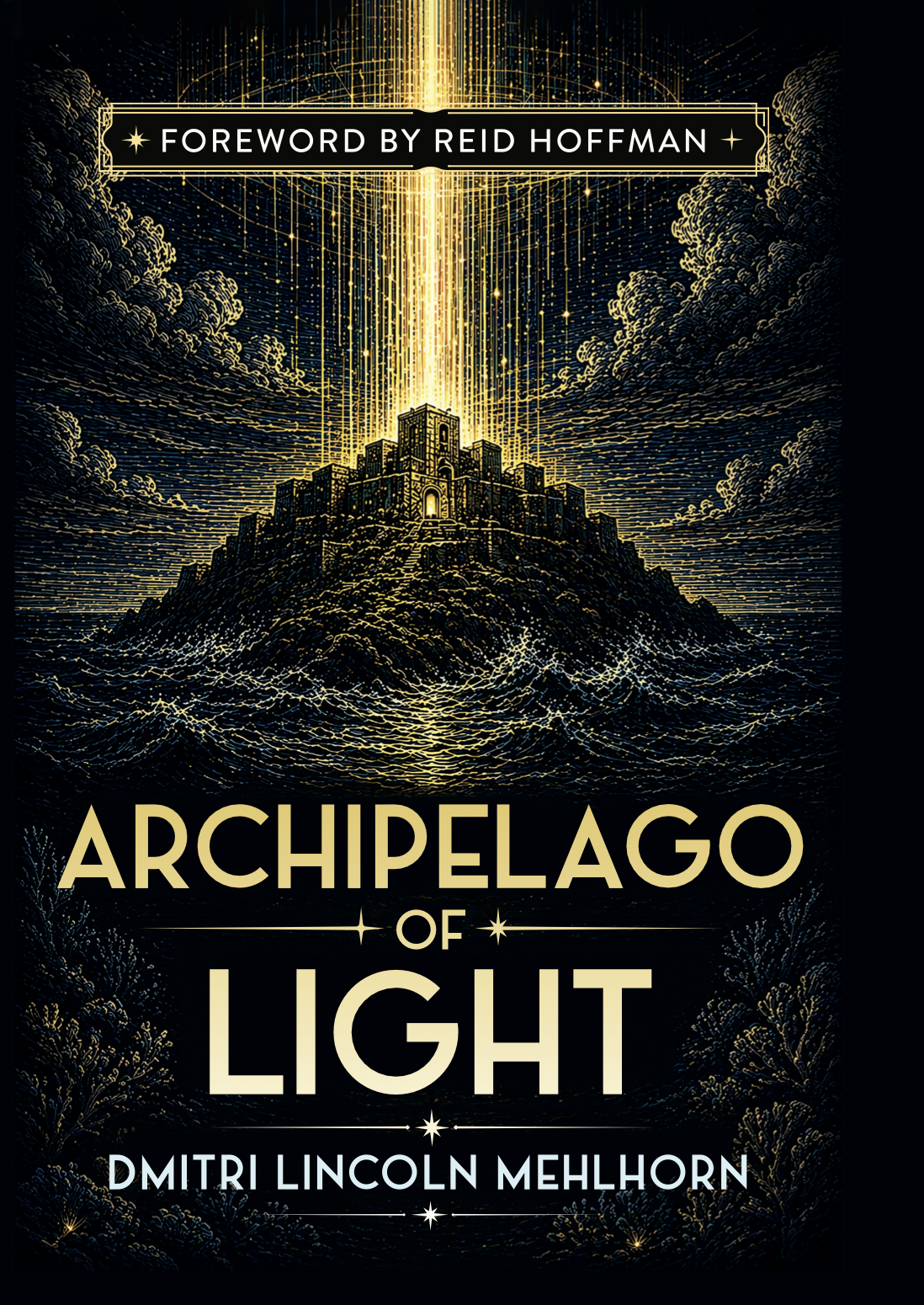
My favorite bit of Archipelago of Light is the arc of the central protagonist, Reem al-Jabri.
We meet Reem in the baking heat of a refugee camp in Jordan. She is eight. Her father has died, and she worries about her mother’s illness. One day, she and her friend Malik notice visitors wearing augmented-reality goggles and strange devices on their fingertips. As the kids watch, the men talk and gesture at things that aren’t there. Malik says: “Those are the goggles … that show things that aren’t there. I want those goggles.” Reem responds: “I want the finger thing. The goggles just show you things. The fingers … make what others see.”
Only after the novel was complete did I recognize my dad in Reem. In 1950, seventy-five years before we meet Reem in 2025, my father was eight years old. He was also a war refugee, penniless and effectively fatherless. I did not consciously model Reem on him. Their lives are very different. But once I saw the resemblance, I couldn’t unsee it: two eight-year-olds standing amid the wreckage left by adults, treating intelligence and education as ways out.
The book follows fourteen years of Reem’s life, from childhood through young adulthood. The questions she begins asking in Za’atari are immediate: Which adults can be trusted? Which stories are true? Which systems actually work?
As her world expands, so does the scale of those questions. Reem and her friends begin building institutions—markets, media, systems of verification and governance—designed for a world in which artificial intelligence makes both knowledge and deception vastly more powerful.
When I stepped away from electoral politics to write Archipelago of Light, I wanted to explore how societies can maintain enough trust to survive when their citizens profoundly disagree about what is true. Reem’s story became a meditation on something more personal: moving from argument to reflection. For most of my life, from school through business through politics, I entered rooms knowing my side and my goals. That urge to fight became much more personal and intense in 2017, when I did everything I could to prevent a Trump re-election. I saw my country split into camps that inhabited radically different truths. In the heat of that fight, people become allies, enemies, or persuadable constituencies. Inquiry and advocacy sometimes conflict, which is why the war college is not on the front lines.
Reem’s answer is not to suppress conflict, but to make it useful to truth-seeking. In 2039, at the age of twenty-two, Reem is the Chief Interlocutor for the new nation of CoralNet. This makes her the leader of a new kind of nation, where AI copilots are deeply integrated into citizens’ lives, citizenship is tied to neither blood nor soil, and AI-mediated deliberation supplements elections. With her peers, Reem has developed new laws, norms, businesses, and technologies as CoralNet grows to absorb millions of climate refugees.
Some of this required legal gymnastics. For the novel, I developed hypothetical cases that CoralNet might confront through 2050. One involved a father denied citizenship because of his avowed illiberal beliefs. The real-life Atoll Society used that fictional case for its 2025 Karl Popper Prize, asking law students to critique the decision. Their papers helped me understand how Reem’s legal system might decide who belongs.
But Reem is not just a lawyer or politician. She has made moral compromises. She has led her nation through war. She has lost friends.
She has killed.
At the end of her final vignette, Reem is standing at the edge of the wedding of two friends, talking with her AI copilot Zari, whose personality incorporates memories of her mother and grandmother. Reem is worried about her nation and her friends. Zari says: “Habibti, whatever is coming, you will face it, and become what you need to become.” Reem responds: “I know. That’s what scares me.”
To find enough shared truth to bind a new nation, Reem chooses the Enlightenment ideals of humanism, law, and science. This makes her different from the other characters in the book. Sofia Morales uses social media and AI to manufacture a new religion. Zhao Meilin helps shape the shared reality of Chinese authoritarianism, while understanding that the system is shaping her in return. RusAmericans define truth by loyalty to a singular leader. In the feral zones, truth is whatever it takes to survive another day.
Reem does have allies. Ruth Locke’s scarred oak dinner table represents machloket l’shem shamayim, the Jewish tradition of argument “for the sake of heaven,” in which adversaries can disagree profoundly while remaining participants in the same search for truth. Her son Kaspar turns that principle into Gaming Salons, deliberately assigning people incompatible objectives in the hope that structured conflict will reveal something none of them could see alone. (The real-life Atoll Society runs Gaming Salons as simulations for the same reason.) Kaspar comes to befriend and mentor Reem, providing her with philanthropic support through the mysterious Atoll Society. Reem and Kaspar work together to build a universal biodigital interface (UBDI) that can accelerate supercomputing by combing human and artificial intelligence with the vast and diverse intelligences of animals, plants, and fungi.
With her friends in the refugee camps, Reem builds verification at the scale of a nation, where people can work and trade and live without seeing the same reality. She does not try to eliminate disagreements. She builds systems that depend upon them. Her Enlightenment Press creates trusted knowledge without requiring everyone who uses it to share the same politics, culture, interests, or worldview.
But Reem never just wants the goggles. She wants the finger thing. She wants to make what others see.
My favorite bit of the book is watching that idea travel across Reem’s life: from an eight-year-old refugee trying to understand whom she can trust to a twenty-two-year-old building institutions for millions of people who do not see the world the same way. The philosophy of her schoolroom in one generation becomes the governing philosophy of the next.
LINKS:
BIO:
Dmitri Mehlhorn is an attorney, entrepreneur, investor, and Democratic activist. A graduate of Stanford University, Harvard University, and Yale Law School, he has held leadership roles in business and consulting, including managing global operations at Gerson Lehrman Group and serving as President of Bloomberg BNA. As co-founder of Investing in US, he mobilized risk capital for organizations safeguarding elections and rule-of-law institutions. He is known for his work on public policy, political strategy, philanthropy, and efforts to strengthen democratic institutions. He has contributed commentary to publications including The Atlantic, The Daily Beast, and The New Republic.
Drawing on philosophers such as Karl Popper, Hannah Arendt, and Carl Sagan, Dmitri also writes science fiction to stress-test the century ahead: the thermodynamics of intelligence, the engineering of shared belief, and the question of how open societies survive when their foundational assumptions no longer hold. He founded the Atoll Society, which pressure-tests speculative ideas against coalition math, resource constraints, and political reality, ensuring that imagination remains accountable to execution.
With his wife and daughter, Dmitri splits his time between the United States and Saint Kitts. Archipelago of Light is his first book.
*Mary Robinette an affiliate of Bookshop.org and will earn a commission if you click through and make a purchase. This does not increase your cost; it simply helps support her work