
Neve Maslakovic is joining us today to talk about her novel, That Murder Feeling. Here’s the publisher’s description:
Rod Gray has a gift that’s both a blessing and a curse: he can see emotions. And hear them, touch them-even inhale them. He’s given a name to the inside-out worlds he encounters, with their strange botanical growths, weather, and creatures: soul gardens. It’s a noisy way to walk through life, but in 1985, in his small Minnesota town of Two Lakes, it helps him discern what others cannot.
There’s one soul garden he’s never wanted to enter. A killer’s.
Until now. When the town’s richest man is found dead in a blizzard, suspicion lands on Rod’s childhood friend, Clementine Baker. Someone sabotaged the victim’s car, stranding him in the woods. There are plenty of suspects and one big problem: Rod has no idea what to look for. The feeling left behind in the culprit’s soul could be anything-a thorny vine, a lurking serpent that hisses I did it, or something entirely unexpected.
Meanwhile, old feelings for Clem clash with growing doubts about her innocence. The police are closing in, his heart keeps getting in the way, and time is running out. Rod must find murder’s mark before the killer strikes again.
The first Soul Garden Mystery. A genre-bending whodunit of snow, small-town secrets, and a whole lot of tangled feelings.
What’s Neve’s favorite bit?
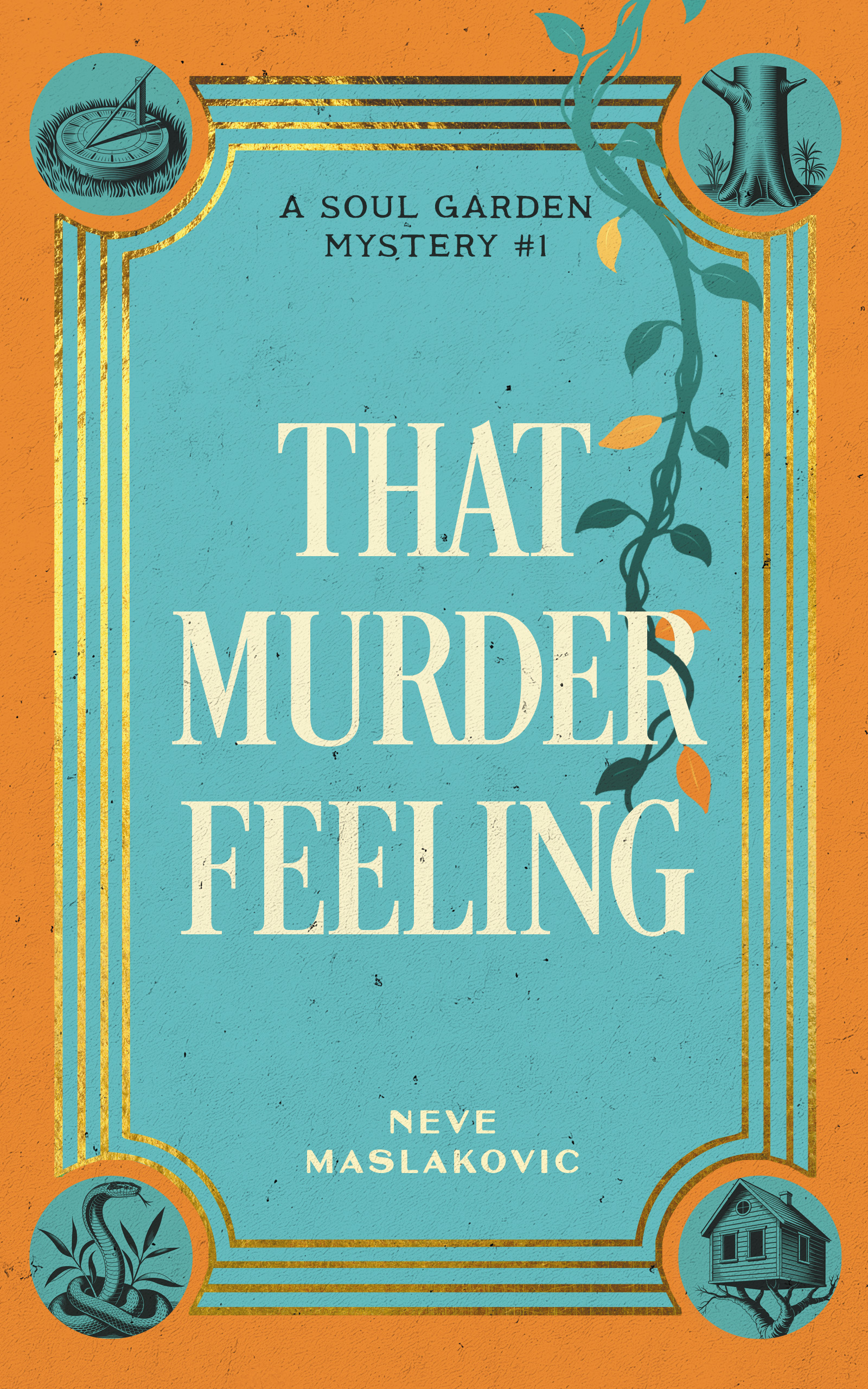
When I first sat down to write what would become the genre-bending mystery That Murder Feeling, the idea I started with was this: A small-town detective has a special gift. He can see feelings, emotions, and moods (and not just see but hear and inhale them). To Rodrick Gray, other people’s inner worlds are gardens chock full of growths, inconvenient weather, and odd creatures. As for Rod himself, the strongest of his own feelings are packed away in fragments of a meteorite he found as a child. His inner world is sparse.
So far so good.
Here is where I made a grave miscalculation. Tremendous. HUGE.
It’s a mystery, I reasoned. There’ll be a handful of emotions that come up, the ones that usually provide a motive in classic whodunits. I looked up the subject of Emotion Classification on Wikipedia and found discussion of the “four basic types” (fear, grief, love, and rage). Or possibly six, or fifteen, or, according to researchers at University of California, Berkeley, as many as twenty-seven.
I’m not a researcher in the field and my goal wasn’t to come up with some sort of exhaustive listing of everything that can grip the human mind and heart. I knew the book’s theme—why I chose it is a subject of a different essay—and it was simple enough: Feelings may be necessary but they can be (are) hard. Rod would have it easy by storing most of his inner turmoil away. He’d sit in his armchair and sketch what he sees around suspects and clients and witnesses. Greed, envy, fear. Not a long list, not in a mystery.
Boy was I wrong. Starting from Chapter One, I realized that a handful was a wild undercounting.
What I’d forgotten—or maybe never realized until sitting down to write the book—is that life (and therefore fictional representations of it too) is made up of moments tightly wrapped in feelings and emotions. We rarely do a thing, however small, without feeling some way about it. It’s morning and we’re brushing teeth. Maybe we’re bored with the repetitive task. Or dislike the taste of the new toothpaste. Or our mind is on something else entirely: we’re worried about the day’s presentation, or proud of a drawing our kid made yesterday, or panicking because we overslept, or happy with the new haircut as it looks in the mirror. Or all of those at once. It’s a constant background churn to our lives. An abacus whose beads slide down rods, one after another in an infinite loop. I feel… So much can follow that verb.
The way it works is, Rod Gray can only see what’s in a suspect’s soul garden in the moment, let’s say noon. He has no idea what the person felt an hour ago, or two hours—or ten days earlier, when the crime happened. He takes in the garden around his suspect and notices a sign that the person feels the need to deceive. But is the deception related to the crime, or due to an innocent reason? And then there’s the extraneous stuff muscling in: the suspect could be hungry and thinking about food, or maybe they’re in love, or worried they’re about to get fired. A lot for Rod to sift through and figure out what matters and what doesn’t. To sketch into his notebook.
And he’s got one more problem. Rod has no idea if there’s some kind of murder feeling, a remnant of the crime hiding behind all the rest. Or what it might look like.
As the word count grew, so did the clutter in my notes. In the end I had to alphabetize everything so I could refer to the list as needed. (If you’re a writer, I use Aeon Timeline to keep track of timelines and other organizational tidbits.) For this 90,000-word mystery, I ended up with 75 (seventy-five!) named garden elements in Rod’s catalogue. Here are some of them:
Disapproving Gargoyles
F5 of Rage
Fern of Aversion to the Sight of Blood
Fireflies of Infatuation
Heavy Mud of Guilt
Silver Fog of Deception
Thunder-in-the-Distance of Irritation
I could go on, but you get the point. Once I got over my surprise at the sheer number of feelings that kept popping up page by page, I had fun inventing gardenly representations for each of them. Mild spoiler, yes, there was one for murder. I won’t reveal it here.
Maybe it happens to some extent with every author and every book they write. The writing process teaches, takes you unexpected places. My favorite bit, then: The feeling that the writing of this book instilled in its author. Astonishment.
LINKS:
BIO:
Neve Maslakovic is the author of six novels, starting with Regarding Ducks and Universes (“Weaving together physics, philosophy, and wry humor, Maslakovic’s inventive debut is a delight.” — Booklist). Her speculative fiction leans towards cozy, with plenty of mystery twists and humor. Neve’s life journey has taken her from Belgrade, Serbia to a PhD at Stanford University’s STAR Lab to her dream job as a writer. She lives south of the Twin Cities with her husband, son, and high-spirited goldendoodle. SFWA and MWA member.
*Mary Robinette an affiliate of Bookshop.org and will earn a commission if you click through and make a purchase. This does not increase your cost; it simply helps support her work