
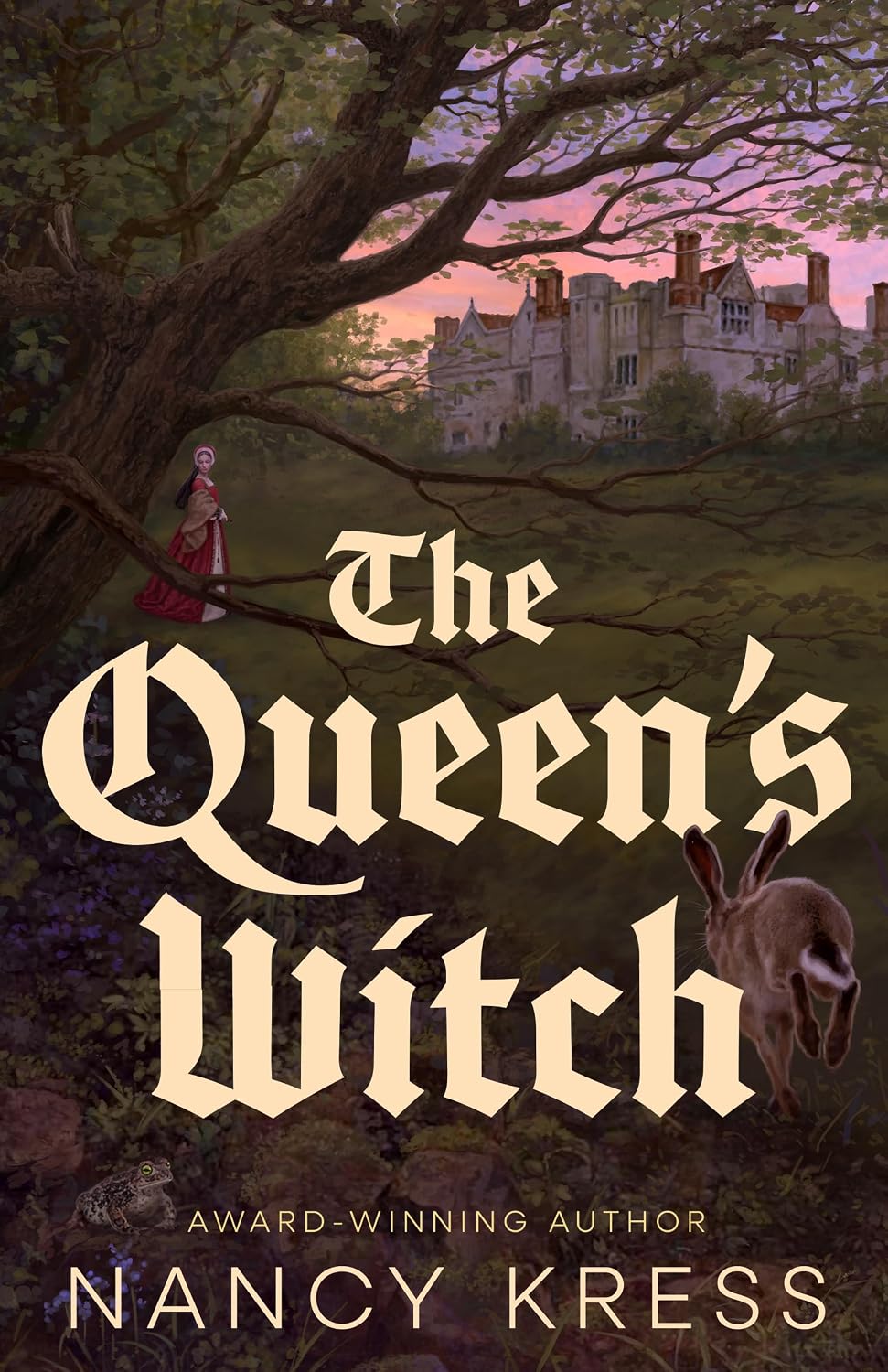
Nancy Kress is joining us today to talk about her novel, The Queen’s Witch. Here’s the publisher’s description:
Alysoun Rowe descends from an ancient line of cunning women–healers and hedge witches whose full power only awakens when they bond with their destined Third. But after a spell goes frightfully wrong, she discovers her familiar is no ordinary object or animal. It’s a distant kinswoman: Anne Boleyn, a brilliant young lady on the rise in King Henry VIII’s luminous yet treacherous court.
Anne will do anything to wear the crown of England. And Alysoun will go just as far to unlock the wild magick spiraling inside her, even if it means breaking her coven’s age-old rules.
As the king’s desire morphs into a dangerous obsession and a ruthless witch hunt closes in, the two women form a reluctant truce. Bound by fate in a realm of lust, rivalry, and betrayal, they each face a choice. But how far will they go to seize power in a world that would gladly watch them burn?
What’s Nancy’s favorite bit?
It is interesting to write scenes of flirtation or love between two characters, but not as much fun as writing arguments, fights, and heated exchanges. This may be due to the perversity of human nature, or perhaps to the perversity of writers. It is especially satisfying to compose heated arguments between strong, unyielding characters. And no two characters in Tudor history were more headstrong, heated, or prone to argument than Henry VIII and Anne Boleyn.
He wanted her as his mistress. She wanted him to divorce his queen, Spanish princess Katherine of Aragon, and marry her. For eight or nine years she held him off, promising sexual satisfaction but insisting first on the crown. This is especially remarkable because a woman in Henry’s court held little power, and Henry held so much. Anne has always fascinated me by the sheer size of the gamble she was willing to take, and because of her tactics for doing so: charm him with banter and promise, give in a little, retreat, pick a fight, wait for him to return to her, repeat and repeat and repeat.
Witnessing these tactics in The Queen’s Witch is Alysoun, a minor witch (the term then was “cunning woman”) who is, in her own way, as determined as Anne. Alysoun needs the aspiring queen for Alysoun’s own purposes, and both women are fully aware what the other wants. Alysoun has managed to become Anne’s taster. She crouches beside and slightly behind Anne at meals, feasts, and private suppers in the privy chamber, in order to use a combination of taste and minor magic to detect any poison. She often thinks Anne’s dangerous behavior risks losing Henry completely.
This is one such occasion. Henry has made a public speech designed to convince important people that he wants to divorce Katherine solely on Biblical grounds, since Katherine’s first husband, who died shortly after their wedding, was Henry’s older brother. Anne has reacted by being cold and distant to the king—at first, anyway.
Finally he blurted, “I cannot help it, sweetheart. You know I must do whatever will influence Campeggio.”
“Do you seek to influence the Spanish ambassador, too?”
Henry looked confused. “The Spanish ambassador? Chapuys?”
“He is still the ambassador from Spain, is he not?”
“I do not see what—”
“Did you know that he calls me ‘the Concubine’? With the singular ‘the,’ as if there has ever been only one, and neither Bessie Blount nor my sister Mary ever warmed your bed.”
The king flushed purple. I held my breath, sure that this time Anne had gone too far. But Henry held his explosive temper in check. “Forget Chapuys. He does not matter.”
“Nor does the crowd today who heard you say that if you could, you would choose the Dowager Princess ‘above all other women’ to marry again?”
“I said ‘if the marriage be good.’ It is not. I have also. . . stop that racket and leave us!”
The musicians making the ‘racket,’ a gentle ballad, looked startled and left more quickly than any musicians since the beginning of time. I awaited a similar order, but the king had either forgotten I was there or was too enraged to care.
“Anne, I have done—am doing—everything I can to shed Katherine. I have offered her honorable retirement to a nunnery, as did a French queen when she could not produce an heir. I have complained to the Privy Council that Katherine shows herself to the people too richly dressed for a dowager princess, and the Council has spoken to her. I have tried everything I know, given you everything I can think of to please you. I have raised your father in rank. I have pressured Campeggio and Wolsey and, I swear, God Himself to bring this business to an end. And still you reproach me. What more can I do?”
“You can leave me what shreds I still possess of my reputation by not implying in public that Katherine is your first choice and I am only your whore!”
The king stood so abruptly that he upset a dish of suckets, which fell on me. “You are not even that,” he said, his face purpled. “I would get more satisfaction from you if you were. I give all, you give nothing, and I am by the grace of God the king of England !”
He stalked from the room, leaving Anne alone at the table and me covered in preserved cherries and sticky syrup.
Alysoun will end up facing more than sticky syrup before she and Anne Boleyn have finished with each other. Anne and Henry will have more, and far more serious, fights. But Anne trusts her flirtatious charm and Henry’s lust to win herself a throne. Alysoun can trust nothing but her magic, which has great limitations unless she can convince Anne to bond with her. Neither the two women nor Henry has it in their natures to back down.
And they don’t, each fighting on until the end. That, too, was—well, maybe not fun to write, but certainly absorbing. Writers— perverse people, yes.
LINKS:
BIO:
Nancy Kress, a SFWA Grand Master, is the author of thirty novels, many about genetic engineering including Beggars in Spain. She also authored four story collections and three books on writing fiction. Her work has won six Nebulas, two Hugos, a Sturgeon, and the John W. Campbell Memorial Award and been translated into two dozen languages, none of which she can read. She has taught writing at various venues in the United States and abroad, including Clarion, the University of Leipzig, Taos Toolbox with Walter Jon Williams for sixteen years, and an intensive seminar in Beijing. She lives in Seattle with her husband, writer Jack Skillingstead, and Pippin, the world’s most spoiled Chihuahua. The Queen’s Witch marks her return to fantasy, where her career as a novelist began forty-five years ago.
*Mary Robinette an affiliate of Bookshop.org and will earn a commission if you click through and make a purchase. This does not increase your cost; it simply helps support her work