
Marie Vibbert is joining us today to talk about her novel, Multitude. Here’s the publisher’s description:
We float to the surface, and we see that there is more to the world than the ocean. We see stars.
Then one day, we hear a song from far away.
It could be nothing, a new dance of energies made by stars muttering to themselves… but it could be everything. We pull tight to your direction in the hope that the universe may gift us a conversation. A banquet.
In Australia, a SETI Technician asks her colleague, “A fake from 44 parsecs?”
In Nevada, a soldier flinches as unidentified craft fly overhead.
In Beirut, a mathematician pets her cat and thinks about language.
We are coming. For the hospice orderly with open arms, the seamstress in her alleyway shop, the lawyer angry at her neighbor’s sloppy garden.
For you are many, and cannot speak as one.
And yet we see you communicate without words. We see you organize and build.
We see you killing us.
For fans of Ray Nayler, Ann Leckie, and Martin MacInnes, follow the hivemind of cephalopod aliens and explore the power of language, community, and hope.
What’s Marie’s favorite bit?
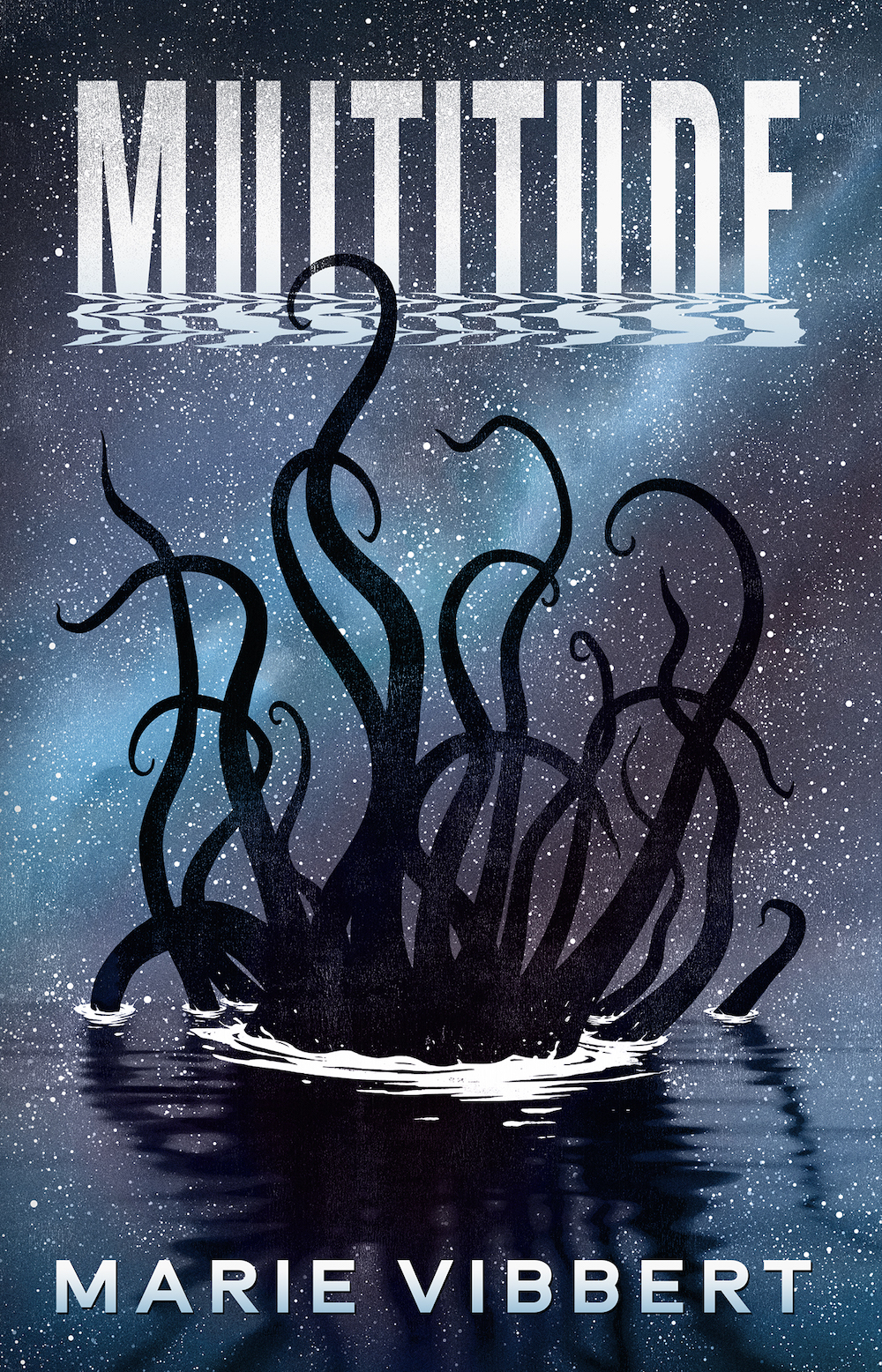
It sat in my “short stories” folder for almost a decade, an unfinished fragment that I thought might become a flash-fiction titled “The Borg, but good.” The premise: a hive mind comes to Earth, from the hive’s perspective, and they’re the protagonists, with the reactionary, fragmented humans as antagonist.
It was a good premise, but as we all know once we start writing stories, a premise is not a plot. I had no idea how to move past this fragment: a few sentences of the hive mind perspective, excited because they had caught a signal from humanity.
We are content. All is calm. We float to the surface; we have heard a song from the stars.
…and so on for about two hundred words. I’d open it up now and then, when I wanted something new to work on, tweak a phrase, add a word, and close it.
It might never have come to anything if I hadn’t had to go to New York City to get a visa to visit China, which I only did because I was nominated for the Hugo award and the convention was offering to pay for my entire trip. It seems magical now, looking back. Me, the girl from the projects, dropping everything to take a train to New York (something I once would have considered as out of my reach as China) so I could celebrate a major award for my “hobby” that would “never earn me a living.”
My train arrived in New York at eight in the morning, and my appointment at the embassy wasn’t until noon, so I did what you do: I walked to Central Park. It was an unseasonably warm day in February and a feverish air of festival dominated. Humans and pigeons walked about with a sort of dazed wonder at the blue sky and gentle breeze, while the remnants of brown slush piles melted in the shadows. I found a warm rock to sit on and opened my writing journal on my knees. On the path below, a middle-aged man was herding a flock of the elderly. He was light brown, balding, in cartoon-print scrubs, and what struck me was his joy and gentleness as he caught a woman about to steer her walker into a trash can and set her back on course. He was chatting, moving from one to another of his charges attentively, more enjoying their enjoyment of the day than the day itself. I wrote two pages, quickly about him. I titled it “The Orderly.”
My journals are full of passages like this, cribbed from life as possible story-fodder. This one, though, felt special. I was certain it would become something.
I drew a sketch of a bare tree, ate a hot dog, and set about finding the embassy, where I learned my “appointment” was actually just a suggested time to start waiting, so people wouldn’t all come in at once when they opened. Also, embassies feel like the DMV. A great disillusionment.
Fast forward to a few weeks later; I needed to write something for a class I was taking. A short story by Friday. I flipped back to the entry about The Orderly and I started brainstorming plots for him. I had to make it science fiction, of course, and then it hit me like a crack of thunder: a way in to the story about the hive mind, through the ordinary people affected by their arrival. The day the aliens came to Earth, an orderly was working in a hospice.
I didn’t write the story from the orderly’s point of view, but from a misanthropic administrator he works with. I wanted her envious dislike of his goodness to sharpen it. The first opening: Truly selfless people are unnerving. I feel a dirty desire to prove they are as mean and greedy as the rest of us. Who can be a friend to a saint?
There is nothing I love to write more than a character introduction and exploration. Of course the narrator would come around and end the story weeping tears of friendship for this man after they see an alien craft together. What a sweet arc.
The Orderly was the first complete chapter of Multitude written, and it will always be my favorite. It’s Chapter 12 in the novella as printed. I sent it out eleven times as a flash piece while I wrote the rest. It was rejected eleven times, and each time I thought: How can you DO THAT to Grady? (I named the orderly Grady.)
Like a snowflake forming around a particle of dust, the novella grew out from Grady. I had what I wanted to do: More writing like that. I re-opened that old, old failed draft and wrote the hive mind’s perspective on discovering the humans, now knowing it was to be chapter one of a longer piece. Then I wrote a piece from the point of view of a sequin maker, a mathematician, a seamstress. The Hive part grew longer and longer until I decided to break it up, make it the interstices between the human chapters. Well, a year or so later, the novella was a novella. You can order it from Apex or at your local independent bookstore.
I could not stop writing this book once Grady showed me the way.
LINKS:
BIO:
A Hugo- and Nebula Award finalist, author Marie Vibbert’s short fiction has appeared over 100 times in top magazines like Nature, Analog, and Clarkesworld, and been translated into Czech, Chinese and Vietnamese. Her debut novel, Galactic Hellcats, was long listed by the British Science Fiction Award and her work has been called “everything science fiction should be” by the Oxford Culture Review. She is the editor of the 2026 Triangulation anthology “Bad Romance.” She also writes poetry, comics, and computer games. By day she is a computer programmer in Cleveland, Ohio.
*Mary Robinette an affiliate of Bookshop.org and will earn a commission if you click through and make a purchase. This does not increase your cost; it simply helps support her work