
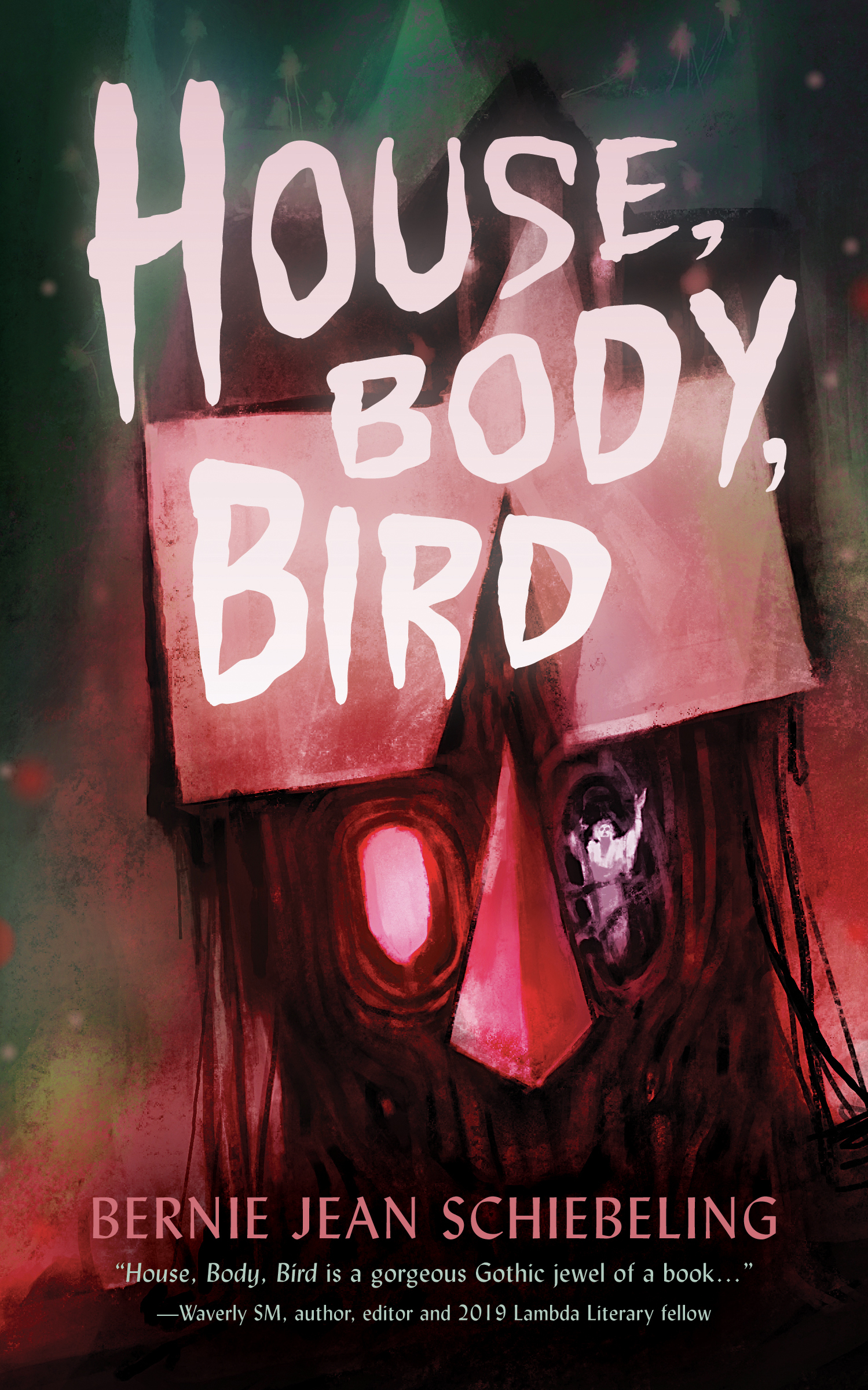
Bernie Jean Schiebeling is joining us today to talk about their novel, House, Body, Bird. Here’s the publisher’s description:
Birdie Goodbain, last of the House’s daughters, thought only the dolls were watching…
Raised in her family’s dollhouse museum, Birdie grew up surrounded by models of perfect daughters that she could never be, haunted by a father who refused to accept her and a mother who wouldn’t protect her. Birdie fled and didn’t look back.
A home, a girlfriend, a job-a summons to the House she left behind.
After ten years, Birdie returns to her mother’s welcoming arms, but something has changed in the centuries-old family home. Strange dogs hide in the foundations, her bedroom door locks on its own, her father won’t leave the basement-and something new and terrible lurks behind her mother’s eyes. She knows that she should leave, but eyes far older than the dolls’ have been watching her.
The House allowed Birdie to escape once. It refuses to let her shame the family again.
What’s Bernie Jean Schiebeling’s favorite bit?
Dollhouses are all about boundaries: the painted exterior versus the cutaway interior; the kitchen, the dining room, the bathrooms, the bedrooms, all set apart from each other with thin walls and color-coordinated wallpapers; the lonely attic and staircases versus the lived-in bits where you’re meant to linger. We understand each room’s purpose by the objects within it, and so each space takes on a distinct identity, a role within the house.
It can be easy to extend those ideas to the doll families themselves. What does each family member look like, and where do they belong inside the dollhouse? If a father doll is wearing a suit, and a mother doll is wearing an apron, what kind of work might we assume each of them does? If there are only father, mother, and children dolls, what does that imply about family shapes?
“Dolls as tools of social reproduction” is a longstanding worry regarding children’s toys—but dolls are also instruments for child-led storytelling, and children’s stories aren’t limited to recitations of conventional values. They can be fantastical, adventurous, surprisingly grim. One of my earliest Barbie dolls was a mother and baby set. Tiny baby clothes, milk bottle, crib with a pink canopy, the whole shebang. And the first game I played with it?
The baby had been kidnapped. By a ghost.
It’s been around twenty-five years since that playtime, but I’m still delighted by narratives that break boundaries or explore unexpected alternatives, revealing that those all-important rules were just another imaginative story we were telling ourselves. This is an important aspect of queer media (and of queering existing media), and I try to build this disruption into my writing whether or not I’m working with LGBTQ+ characters.
In House, Body, Bird, much of the Goodbain Miniatures Museum is dedicated to upholding rigid divisions. Birdie’s bedroom is devoted to idealized, mid-century suburbia, while another guest bedroom features exclusively heterosexual wedding dioramas. At the story’s start, nearly all the dolls are glued down, so there’s no possibility of evolving storylines or personalities through play. The dolls are just as trapped and isolated in their houses as Birdie.
However, as much as I enjoyed scheming over uncanny museum exhibits, my favorite bit of the novella came from designing the exceptions to that rule. I can’t go into all of them without spoiling the book’s ending, but I can at least tell you the setup.
There are very few places in the house where Birdie feels comfortable. One of them is the tower, where a tight spiral staircase reaches the upper floors and the rounded walls are covered in found-object dollhouses. Wine bottles, hollowed-out books, old computer monitors, violins: each one is something that was never meant to be lived in, but which has become a home nonetheless. During difficult days, Birdie eats her food perched in the middle of the spiral staircase, ready to flee in either direction. I like to think Birdie also feels safer there because the displays remind her that there isn’t a single right way to live, to be in a family, to make a home. On those difficult days, Birdie is doing her best to keep herself safe, and she feels less alone while she does it. A house has windows, doors, and rooms set apart from each other, but “home” has a much more flexible definition. The tower reminds her of that.
(Also, at the story’s climax, we return to the tower, and there’s a sentence-level aside about an unconventional wolf-and-cub pairing that I really, really hope someone mentions to me. That’s my other favorite bit.)
LINKS:
BIO:
Bernie Jean Schiebeling (she/they) is a queer author trying to find moments of comfort in deeply uncomfortable situations. She holds an MFA from the University of Kansas, and her short fiction has appeared in magazines including Analog, Reckoning, and Electric Lit – The Commuter. She is also the script editor for the indie SF podcast Gastronaut. When the mood strikes, she makes plush frogs. You can find them on BlueSky at @bernie-jsyk, on Instagram at @bernie_jsyk, and on their website at berniejeanschiebeling.com.
*Mary Robinette an affiliate of Bookshop.org and will earn a commission if you click through and make a purchase. This does not increase your cost; it simply helps support her work