
Clara Ward is joining us today to talk about their novel, Dream the Deep. Here’s the publisher’s description:
You don’t need to reach Mars to reach your dreams.
Robbed of their chance at leaving Earth to pursue green-energy innovations, Ryn embraces new dreams-fighting deep sea threats in conjunction with a giant cephalopod. It’s 2139 in the Cali-Coastal Corporate Zone, and Ryn struggles with their own body and brain as they fight to survive five days locked up with academic rivals and the military-backed billionaires who’ve misled them all since their teenage years.
Ryn needs an exit strategy but doesn’t know whether to trust Akira, the hacker-spy who may have saved their life, or Jay, the geeky military rebel with a secret stash of hot chocolate. Not to mention, Jay keeps falling asleep in their bed, and Ryn’s not sure if either of them is interested in more-but at least they like the same shows!
Five Days. One Ocean. Unlikely allies connect to Dream the Deep.
What’s Clara’s favorite bit?
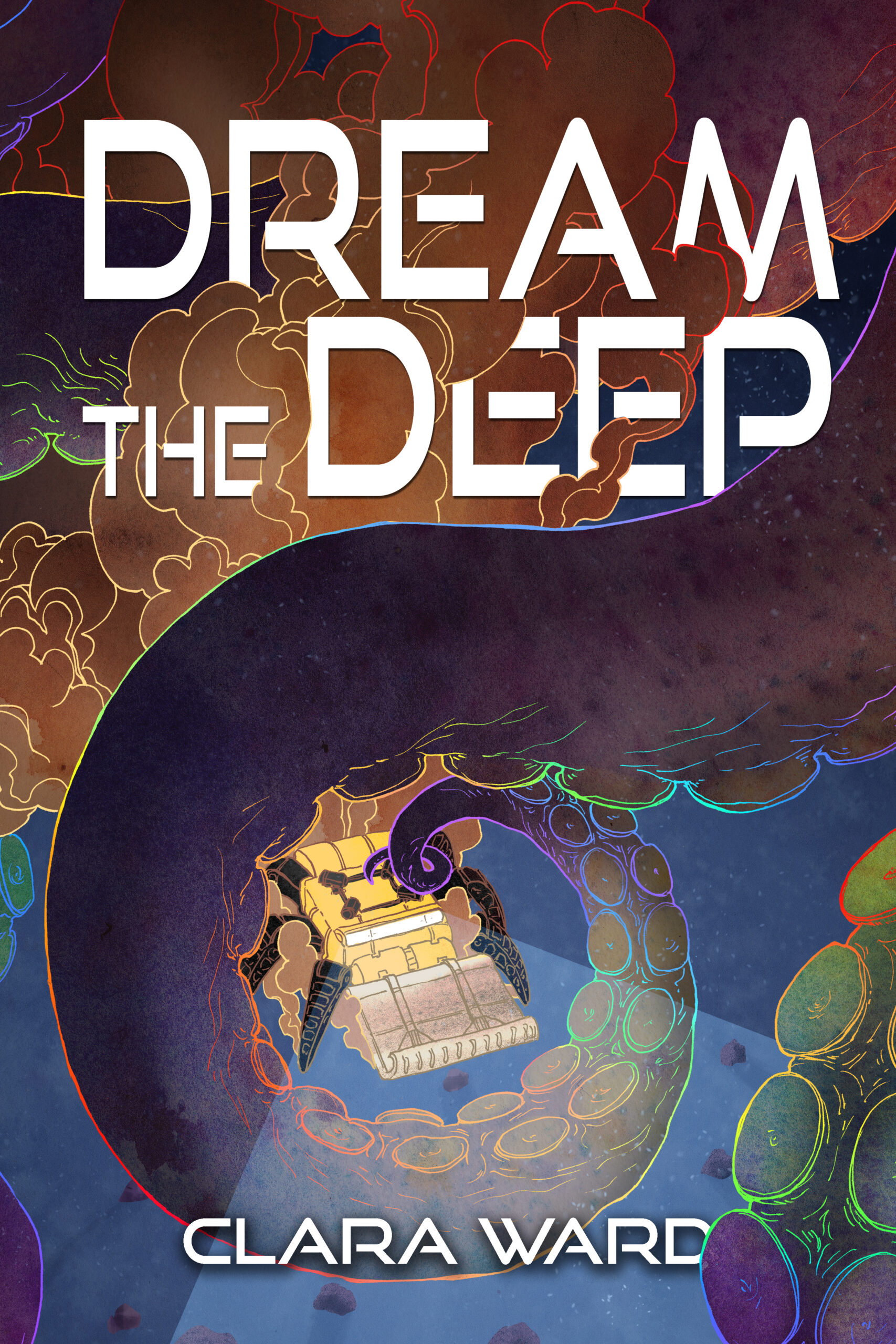
Dream the Deep explores the insular culture of the Academy through the eyes of a young neurodivergent researcher, Ryn, whose assumptions about their personal future and about humans in general are upended in a single day. Incidentally, it’s the same day they first share a dream with a cephalopod.
Dream the Deep is likewise the story of a giant cephalopod, Ceph, who spends a lifetime protecting an undersea crater filled with polymetallic nodules. Ceph learns from the perspectives of each human dreamer who temporarily inhabits one of their many arms. (Each arm has its own brain, so I figure each might as well have its own dreams, and dreamers!)
My lifelong love of the ocean ensured I’d enjoy writing any seafloor scenes, even if figuring out Ceph’s biology and the local marine geology sometimes made those the slowest parts to write. As a child, born in Hawai’i, I learned to swim in tidepools alongside sea cucumbers, crabs, and tiny fish. I swam before I could walk. And in dreams I could breathe underwater and understand whoever I met there (human or not). As an adult who has grappled with painful spine and nerve issues since my thirties, I’ve spent even more time dreaming about being an invertebrate sea creature, albeit for slightly different reasons.
Ryn, as it happens, is also a member of the daily-physical-therapy-for-spine-issues club and, in their own way, drawn to the ocean. Their favorite places to sit offer views of both the land and the water. To manage their anxiety, they picture blue skies over blue-green seas, and they find the scent of seawater soothing. Although touch-averse and ace, they discover early in the story that there is one person whose presence in their space and whose prolonged touch they not only tolerate but welcome. In short, Ryn is drawn to the borders where seemingly different things collide or connect.
That’s probably why my favorite bit in writing Dream the Deep involved letting Ryn and Ceph connect through dreams—a literal meeting of the minds. I didn’t realize until after I wrote it, but I gave Ceph and Ryn a physical barricade to defend:
Ceph-Ryn clutched tight to the stone barricade that hid this side of their crater. Stones they knew as well as their own suckered underside now shook in unnatural ways. Their chromatophores darkened as papillae stiffened to mimic the slope’s pebbled appearance. They hid even as they held their barricade together.
Right there, on the edge, in more ways than one, I present Ryn and Ceph with a shared threat, one with implications for life both above and below the water: an autonomous mining rover. That rover and the environmental threats inherent in polymetallic nodule mining have been bumping around in my mind since 2019. They never quite fit into my previous ocean-centered novel, Be the Sea, which was already a rather chonky book stuffed with sea creature dreams of its own.
With Ceph, Ryn, and Dream the Deep, I approach the issue of seafloor mining from a more liminal space. Embracing my cephalopod-centric point of view, I set aside most of my prior notes about mining test sites and corporate tactics. Let’s face it, few cephalopods would recognize an autonomous mining rover, or consider who sent it, even if they saw it coming. I wanted to know (and for Ryn to wonder) why Ceph would risk life and (shared!) limbs to protect nodules that had been lying on the seafloor for ten-, twenty-, or even thirty-thousand years. What might Ceph know that the humans didn’t?
It was also great fun to image how Ceph, even with some added insights gleaned from human dreamers, might first perceive an approaching marine rover:
The center was distracted. A long, triangular plume of dust pointed to a scraping entity that was not prey. Nor was it any creature known to the center or to any arm.
Like the crustacean, the new entity carried a hard shell above scuttling arms. Rather than pale and partially translucent, the boxy intruder looked metallic, like nodules wiped clean of snow.
I didn’t start out to flip expectations so much as to expose how little we know of our oceans right here on Earth. Nearly ninety percent of the seafloor is too deep for humans to visit, even with specialized scuba gear. Over ninety percent of marine species remain unidentified by humans. I couldn’t resist speculating about one I’d like to meet. Now I invite others to speculate and to Dream the Deep!
LINKS:
BIO:
Clara Ward spends their days in or near the Pacific Ocean in California. Their new novella, Dream the Deep, and their previous novel, Be the Sea, explore sea creature perspectives, marine technology, and chosen family, while delving into our oceans, our selves, and how all futures intertwine. Their shorter works are featured in The Neurodiversiverse: Alien Encounters, Strange Horizons, and Tales & Feathers by Augur. When not using words to teach or tell stories, Clara uses wood, fiber, and glass to make practical or completely impractical objects.
*Mary Robinette an affiliate of Bookshop.org and will earn a commission if you click through and make a purchase. This does not increase your cost; it simply helps support her work