
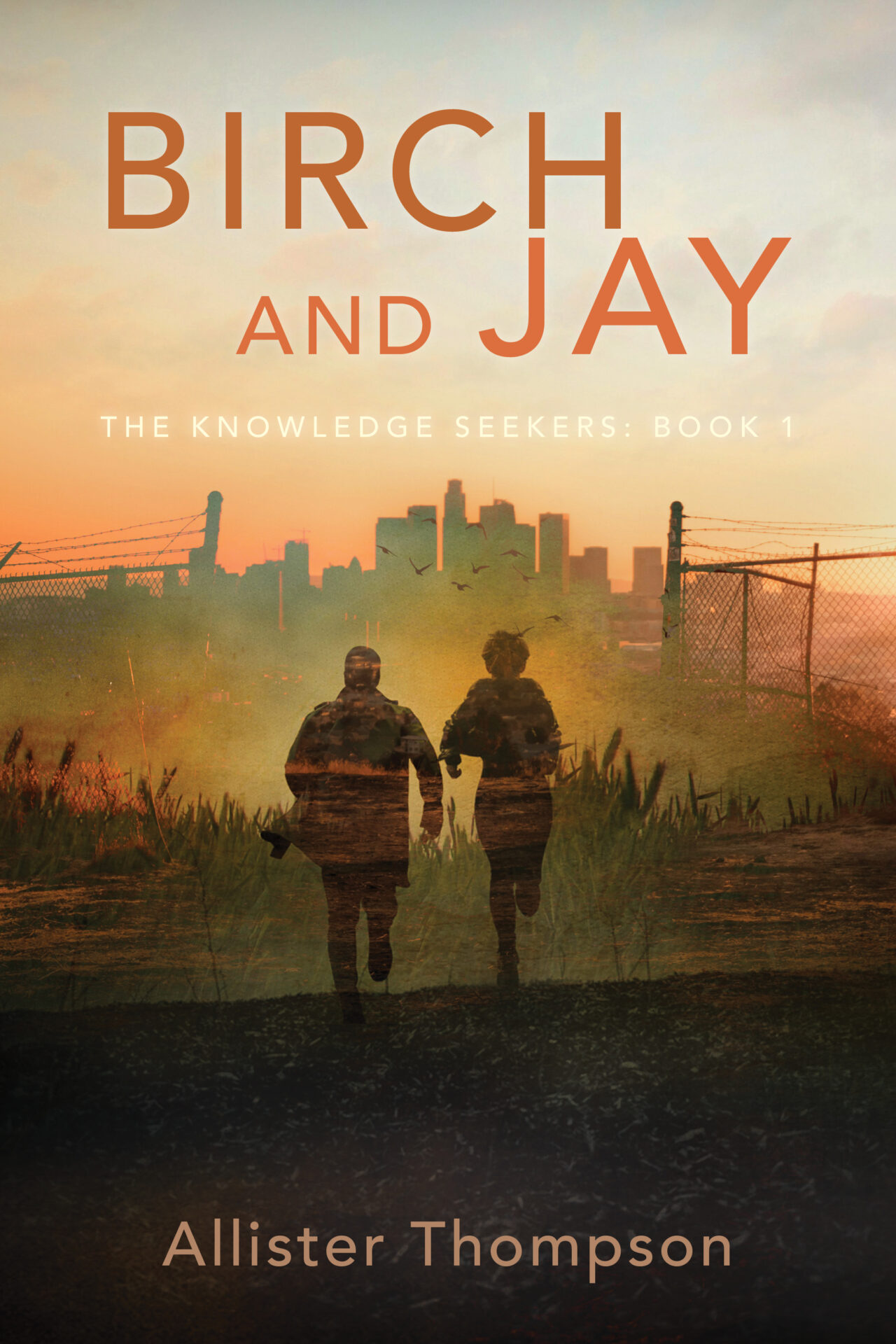
Allister Thompson is joining us today to talk about his novel, Birch and Jay. Here’s the publisher’s description:
Decades after the world was levelled by the effects of human-made climate change, the scattered remnants of humanity have begun to pull themselves together. Birch and Jay are a young couple living in a small, idyllic community away from the ruins of one of Canada’s great cities.
As a newly graduated Knowledge Seeker, Jay must leave Birch and their community to collect remnants of old wisdom from the dead world. Along the way, he comes across a mysterious elderly woman who offers to travel with him. He will receive more than a travel companion — she offers revelations about their town’s founding as well as knowledge of how to survive in a lawless world.
Birch, seeking adventure, pursues Jay but finds more danger than she ever imagined. Will they find each other in the chaos and brutality of the city and get safely back home to tell the tale?
Birch and Jay will reunite in a place where they confront a terrible reminder of humanity’s perennial flaw: repeating the tragic mistakes of the past.
What’s Allister’s favorite bit?
Putting together a finished and polished novel is an intricate process. Sure, you start with your big, overarching idea for plot or theme, and that’s what you’re initially focused on, but along the way, you also need your appealing characters, subplots, evocative settings, etc.
And sometimes the things that come out of your head as you outline all these elements will surprise you! Things you didn’t even know were in there or were that important to you. And that’s how I discovered my favorite bit of my speculative fiction novel, Birch and Jay.
This is a very serious novel that I wrote because of a lifelong passion for environmentalism and a concern about climate change. It’s set 100 years in the future, which, of course, opened up all kinds of possibilities. There were the big questions to be answered: is there anything we can do about climate change? If not, how will we live in the future? And does our flawed civilization even deserve to survive? Most importantly, if it does, how can we be better than this? Do we need newer values, revived older ones? A return to the days before technology started to dominate our lives?
That question was rolling around in my head as I created the scenarios and characters. My people live in an agrarian, utopian community led by valued elders. My two protagonists who set off on an adventure are just out of their teens.
And that’s where things got interesting. Along the way, I not only created a wise elder leading the community, but my main character, Jay, also meets another mysterious elder, Elm, as he leaves his community on a knowledge-seeking mission. I don’t know how that idea came to me, but it just did.
It was there, writing the character of Elm, that I really got inspired. In modern Western civilization, the role of the elder has been diminished. There are many reasons. In traditional and Indigenous societies, elders are the trusted keepers of the continuity of knowledge and culture, as well as wisdom and guidance about how to live well and survive. In those societies, change is slow. Contrast it with now. I grew up in an age of electric typewriters but now essentially have a supercomputer in my pocket.
In our society, constant changes in technology mean that younger people are much more “up” than their elders on the tools of survival and communication, leaving many seniors behind. Popular culture, too, comes only in clumps of a few years. One year you’re listening to grunge and wearing plaid and think you’re the coolest, but fast-forward a couple of decades and now you’re out of style and something else is contemporary. You, the elder, now feel cast aside and undervalued. You may even be the object of scorn.
Yes, most political leaders are older, but they mostly seem painfully out of touch with the realities facing younger people and seem to have little to no wisdom to offer. They created this tech hellscape, after all.
But what if all this tech and all this ephemeral pop culture were to be gone? Well, I surmise that even here in the industrialized countries, we’d return to a more natural ways of living. We’d have no choice.
This was a jumping-off point to create Elm. What knowledge would she have retained, what wisdom? What kind of personality would such a person, one who survived a climate apocalypse, have? I made her resilient, I made her funny, I made her capable. Maybe, in her late seventies, she’s slower than the kids, but she’s fearlessly out there on the roads. There’s no care home or retirement home in a postapocalyptic future, so she’d better darn well be capable.
Similarly, in our town of Norbay from which Jay comes, Cedar, a woman of the same age, dispenses wisdom and wit while guiding the town, like a true elder, respected, with only a little pushback from more impetuous youths.
It was a true pleasure to imagine seniors who carry valuable knowledge and are actually respected for it; who lead by example; who take no nonsense; who are not portrayed as decrepit relics but rather as dynamic figures who still have a lot to give. Sort of like postapocalyptic Jane Fondas.
Creating these two women also gave me one of the greatest brain waves that occurred during the writing of Birch and Jay: a mysterious, emotional shared history between Elm and Cedar. But I won’t offer any spoilers.
I’m proud of quite a few things about this book, since I believe it does achieve my aims in what I wanted to express, and does it in an entertaining way. But the real joy in writing fiction is those little discoveries along the way.
Being able to write about vibrant, respected elders (and ones who actually deserve the respect, unlike many of the older people leading governments today) was an unexpected joy, and I think I’ve created some role models I can follow myself as I near my own “elder” years.
And that’s my favorite bit of this book.
LINKS:
BIO:
Allister Thompson was born in the UK and spent his childhood in Mississauga, Ontario, where he got his first part-time job in a small bookstore at the mall at age sixteen. He has spent the rest of his life working in the publishing and bookselling industries. He worked for small and mid-sized publishers in Toronto for fifteen years before striking out on his own as a freelance editor. This freedom eventually led him to North Bay, Ontario, where he has lived and worked with dozens of authors for the past ten years.