
Tim Pratt is joining us today to talk about their novel, The Jewel and the Comet. Here’s the publisher’s description:
Glenn is a normal graduate student (aside from his kinks and genderfluidity), living a normal life with his normal girlfriend, Vivy (a spy for an interdimensional agency with her own kinks).
When Vivy is called away on a scouting trip to stop a rogue comet, Glenn finds himself pulled from his normal life into an adventure of his own, navigating the multiverse with only a snarky starship as his guide.
Glenn and Vivy are far apart, facing dangerous foes; Glenn battling an evil cult leader with a limitless supply of power, and Vivy trying to recover a stolen jewel with a serious attitude, a jewel that can devastate entire universes. Kinks there may be, but is there a link?
What’s Tim’s favorite bit?
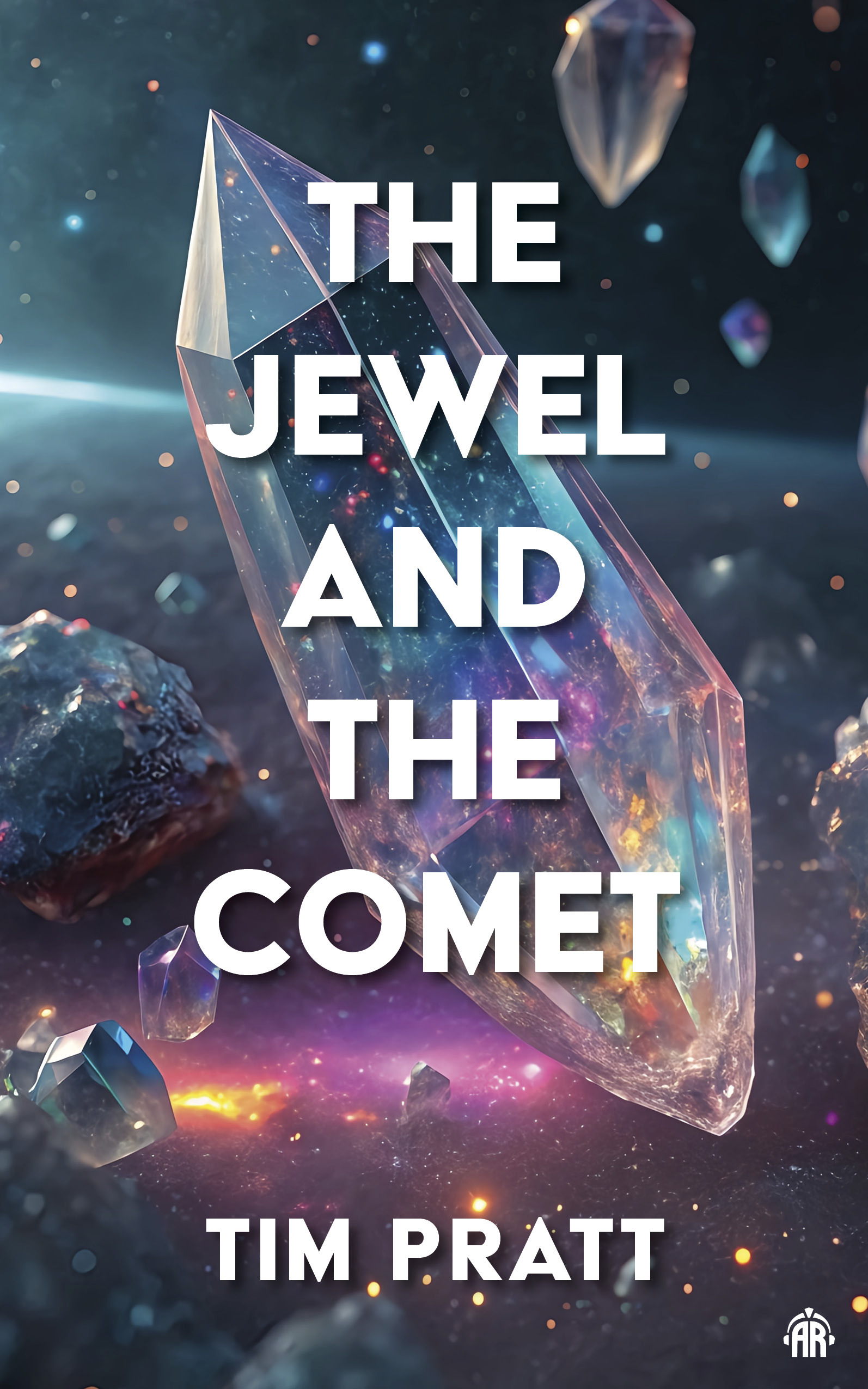
First, a little context: The Jewel and the Comet is the second book in my multiverse/space opera Nigh-Space series, following The Knife and the Serpent from 2024. In book one, genderfluid Berkeley grad student Glenn discovers his girlfriend (and domme) Vivy is actually from another technologically advanced level of the multiverse, and is an agent for a group of dimension-hopping revolutionaries (and/or terrorists) called the Interventionists, who oppose fascism and oligarchy throughout the multiverse. Glenn gets dragged into one of Vivy’s missions, and they have adventures and negotiate the interpersonal fallout from that Giant Secret; the kink-related parts are actually my sneaky way of writing about the importance of communication in relationships.
In that book, we also meet Vivy’s partner and best friend, a sapient spaceship named The Wreck of the Edmund Pevensie, or Eddie to his friends. Eddie enjoys recreational shit-stirring, and loves teasing Glenn about his sex life in the guise of “just asking anthropological questions, I don’t understand human mating rituals.” (He understands fine.)
In book two, Glenn becomes a field officer with the Interventionists, and Eddie is his training officer, which means they spend lots of time together. I got to write some delightfully awkward conversations, but want to highlight a bit that turned more serious. For most of The Jewel and the Comet, Glenn’s genderfluidity has shifted toward the femme side, and so she goes by Gwen, and while they’re surveilling a planet, Eddie asks about that, and Gwen explains:
“Once I started going out in the world while presenting more femme, calling myself Glenn didn’t feel right anymore.” Vivy had really encouraged me to live more authentically. The fact that I shift from femme to masc means I can choose to slip into boymode pretty easily, and present a masculine self to the world regardless of my internal state, and doing so is certainly convenient, and avoids a lot in the way of stares and questions. But doing so doesn’t feel right; going out in boy drag when I’m femme feels like wearing a Halloween costume long after the party is over. “I considered a lot of possibilities. Mara Wilson wrote, ‘Trans women are women, usually just with cooler names,’ and I thought about going by Serena, Harley, Ivy, Melody, Aurora, names I just liked the sound of… but ultimately I picked Gwen because it’s the same initials as the ones I already have, and if someone yells my name at a party I’ll turn my head, because it sounds close enough to the name people have been calling me for thirty years. Also… I just think it’s a pretty name. I always have.” I did not tell him that I was super into the Spider-Gwen comics in high school. Shut up.
[…]
“So the whole deadname thing doesn’t really apply with you then?” Eddie asked.
“It’s a very important issue, but no, it’s not super relevant for me. I’m genderfluid, so my state changes, so sometimes I am Glenn, and other times I’m Gwen. I’ll answer to either, honestly, and as for pronouns, I’m pretty forgiving. If you see me in a dress and make-up, Gwen and she/her are safe bets, and if you see me in jeans with a beard, Glenn and he/him are likely, but otherwise… Sometimes I’m in a kind of androgynous femboy or tomboy phase, and even I can’t tell what really feels right.”
“It all sounds elegant in its simplicity,” Eddie said.
I snorted. “I didn’t choose to be this way. You always say you’re an anthropologist of humans? I’m an anthropologist of myself. I observe and look for patterns. If it was up to me, I would have been something less complicated. Even cis people who basically understand trans people are confused by genderfluidity… and there are some trans people who think I’m a weird poser. It’s like being bisexual: there are even queer people who think you’re a fake or fooling yourself. But I like to think I’m the world’s leading expert on me, so I try to trust myself. I didn’t always.”
It’s a lively conversation which reveals things about both characters and deepens their relationship, so I kept it in the book, even though it’s self-indulgent…. in the sense that I, me, the author, am also genderfluid, though not exactly in the same way as Gwen (it’s complicated). If you see me at a convention, I will most likely be femme, with a nametag that reads Tim Melody Pratt; I go by Melody a lot in my day-to-day life. Tim Pratt is still my byline, and I’m disinclined to give it up after 25 years of publishing anyway, but like Gwen, I’m not that fussy about my name or, generally speaking, my pronouns. (If I don’t know what my gender is going to be from month to month, it seems like a lot to expect other people to figure it out reliably.)
Gwen’s discussion of her gender stuff above is about as blatantly authorial-self-insert-y as I have ever gotten in my fiction, and part of why this is my favorite bit in the book is because it’s relatively new for me to talk about gender stuff so directly, instead of burying it in layers of metaphor and symbolism. (Like many trans people, I didn’t even figure out myself until I’d lived a few decades in confusion and intermittent misery, so sometimes I didn’t even know I was writing about it.)
Given the current state of politics around gender and trans people in the USA and UK, it seems more important than ever to provide some representation in fiction—I know that the few times I encountered nonbinary characters who felt even a little bit like me in fiction when I was younger, it was hugely meaningful, and made me feel less alone. If I can do that for even one other person, it makes this whole doing-art thing worthwhile.
LINKS:
BIO:
Tim Pratt (genderfluid, any pronouns) is the author of over 30 novels,
most recently multiversal space opera The Jewel and the Comet. Pratt
is a Hugo Award winner for short fiction, and has been a finalist for
Nebula, World Fantasy, Sturgeon, Stoker, and other awards. She
publishes a new story every month at www.patreon.com/timpratt and
posts incessantly on Bluesky as @timpratt.org
*Mary Robinette an affiliate of Bookshop.org and will earn a commission if you click through and make a purchase. This does not increase your cost; it simply helps support her work